

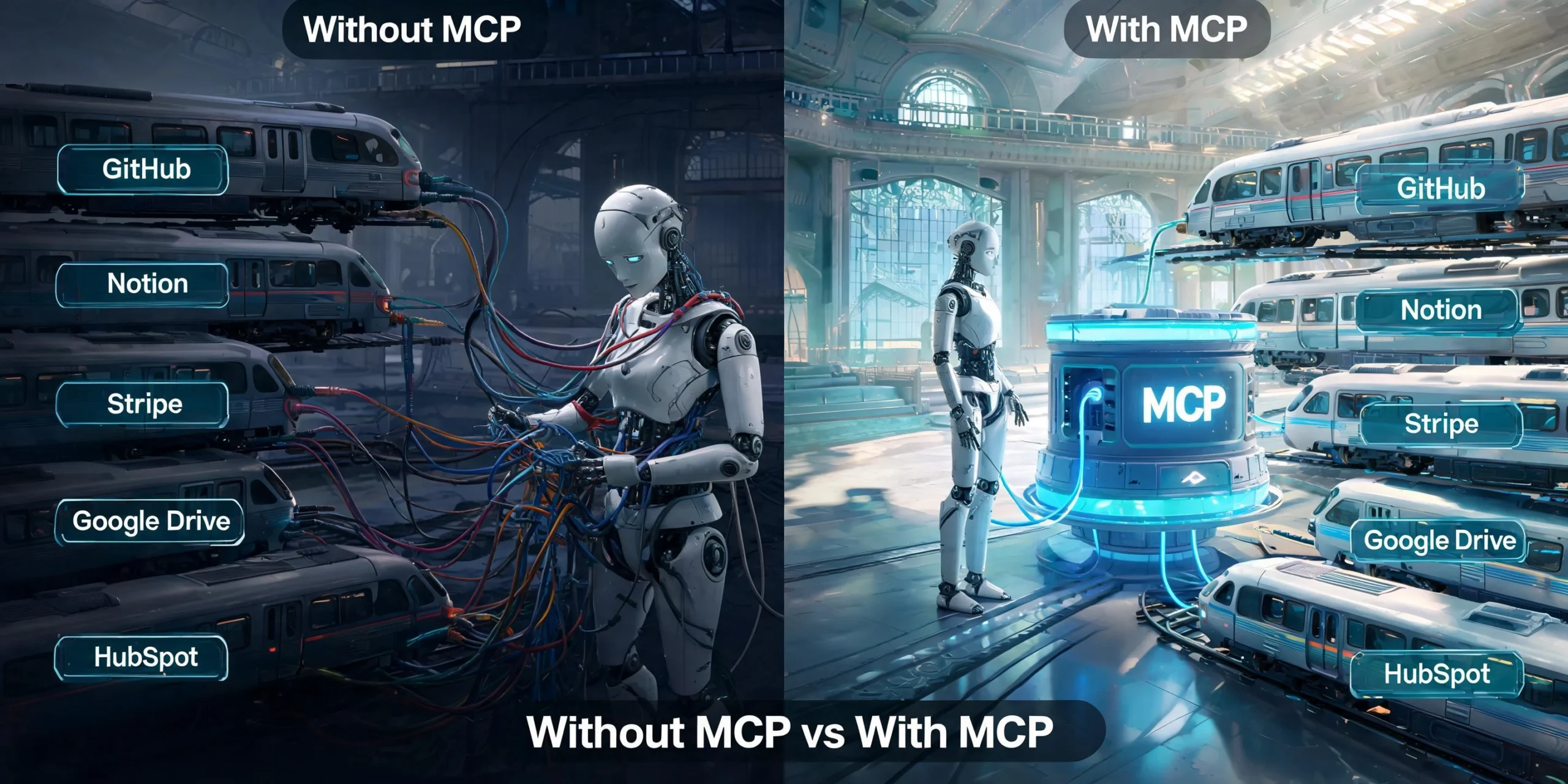
The Problem MCP Was Built to Solve
Before MCP, connecting an AI assistant to external tools was a mess. Every tool — a calendar app, a CRM, a file system — spoke a different “language.” If you wanted your AI to read your emails and query your database and search the web, each integration required a separate, custom-coded connector. Developers called it an “engineering nightmare.”cloudflare
The result? AI stayed trapped inside a box, good at answering questions but incapable of actually doing things. You couldn’t ask ChatGPT to “update my spreadsheet and then send the report to the client” — not without building a fragile, one-off integration stack from scratch.youtube
This is the problem Anthropic set out to fix.
So, What Exactly Is MCP?
Model Context Protocol (MCP) is an open standard that gives AI systems a universal, structured way to connect to external data sources, tools, and applications.anthropic
Introduced by Anthropic in November 2024 and immediately open-sourced, MCP was rapidly adopted by OpenAI and Google DeepMind as well — making it a true industry standard, not just an Anthropic-only solution.wikipedia
Think of it this way:
- APIs are the sockets on the wall — each with different shapes, voltages, and formats.
- MCP is the universal adapter that lets any AI agent plug into any socket without needing custom wiring for each one.
Or, in the now-famous shorthand: MCP is the USB-C of AI.modelcontextprotocol
How Does MCP Actually Work?
MCP uses a straightforward client-server architecture with three key components.cloudflare
The Three-Layer Architecture
| Component | What It Is | Real-World Example |
|---|---|---|
| MCP Host | The AI environment running the operation | Claude Desktop, Cursor, n8n |
| MCP Client | The connector inside the host that “speaks MCP” | The bridge program inside your AI app |
| MCP Server | The external service exposing its tools to AI | A GitHub server, a Notion server, a database |
Here’s what makes MCP elegant: an AI agent doesn’t need to be pre-programmed with knowledge of every tool. Instead, it can send a simple query (tools/list) to an MCP server and receive back a complete, self-describing menu of everything that server can do. The AI then calls what it needs, dynamically — no human developer required in the middle.medium
The Four Types of MCP Messages
Every MCP interaction relies on four message types:cloudflare
- Requests — The AI client asks the server for information or an action
- Results — The server returns the requested data or confirms the action
- Errors — The server signals it cannot fulfill the request
- Notifications — One-way status updates from either side (no response needed)
How a Single Conversation Flows
When you ask an MCP-powered AI assistant to “check my calendar, draft a meeting summary, and email it to the team,” here’s what happens under the hood:
- Initialization — The AI host establishes a connection with the relevant MCP servers (calendar, docs, email)
- Tool Discovery — The AI queries each server to understand what it can do
- Message Exchange — The AI sends requests, receives results, and chains actions across multiple servers simultaneously
- Termination — Each connection closes cleanly after the task completescloudflare
Critically, each server connection is independent — like a team of reporters each calling their own sources, then pooling information to write the story.cloudflare
MCP vs. Traditional APIs: What’s the Real Difference?
MCP doesn’t replace APIs — it builds on top of them. Most MCP servers internally call existing REST or GraphQL APIs. The difference is in who is doing the calling and how capabilities are discovered.medium
| Dimension | Traditional API | MCP |
|---|---|---|
| Designed for | Developer-to-software communication | AI agent-to-resource communication |
| Discovery | Manual — you must know the endpoint | Dynamic — AI discovers tools at runtime |
| State management | Stateless (each call independent) | Stateful — maintains context across steps |
| Integration effort | Custom code for every new service | One standard protocol for all services |
| Best for | Traditional software integrations | Multi-step, context-aware AI workflows |
The simplest mental model: REST APIs are sockets. MCP is the universal adapter that lets any AI agent plug in.medium
What Are MCP Servers? (And Why They Matter)
An MCP server is a program — hosted locally or in the cloud — that exposes a set of capabilities for AI agents to use. Think of it as a translator: it takes requests from an AI in standardized MCP language, performs the relevant action (querying a database, sending a message, fetching a file), and returns the result.cloudflare
Here’s where it gets powerful: services themselves are now building MCP servers. This means instead of every AI company building custom integrations with Notion, GitHub, or Stripe, those companies build one MCP server — and every MCP-compatible AI can immediately use it.youtube
Popular MCP-Compatible Tools (2026)
A rapidly growing ecosystem now supports MCP out of the box:generect
- Developer tools: Cursor, Windsurf, GitHub Copilot, Supabase
- Productivity & CRM: HubSpot, Notion AI, Linear, Jira
- Data & infrastructure: Stripe, PostgreSQL, Google Drive, AWS
- Automation platforms: n8n, Zapier AI, Make (formerly Integromat)
- AI assistants: Claude Desktop, ChatGPT, Google Gemini
MCP for Non-Developers: Real-World Use Cases
MCP is often discussed in developer circles, but its most transformative impact may be for non-technical users who rely on AI-powered apps built on top of this protocol. You don’t need to write a single line of code to benefit.
5 Things You Can Do Today Using MCP-Powered AI Tools
1. Build automated marketing workflows in n8n
n8n supports MCP natively. This means you can instruct your AI agent to pull leads from a CRM, enrich them with web research, draft personalized outreach emails, and log everything to a spreadsheet — all in a single automated pipeline, with no custom API coding.cloudflare
2. Ask Notion AI to reason across your entire workspace
Notion AI uses MCP-style context access to let you ask questions like “What are all the pending action items from last week’s meeting notes?” — and get accurate answers by actually reading your pages, not just guessing.generect
3. Use Claude Desktop to control your local files and apps
With MCP servers for your filesystem, Claude can open files, edit documents, run terminal commands, and organize folders based on your instructions — a true local AI assistant.anthropic
4. Connect your AI chatbot to live business data
Marketers and business owners can use MCP-enabled platforms to let AI assistants query live Shopify store data, Google Analytics reports, or HubSpot pipeline stats in natural language. Ask “What were my top three traffic sources last week?” and get a real answer — not a generic one.ibm
5. Create multi-step research and content pipelines
Using MCP-aware tools like Cursor or Claude, content creators can instruct an AI to research a topic via web search, pull competitor data from a database, synthesize findings, and draft a structured article — all in one chained workflow.cloudflare
How MCP Powers Agentic AI
To understand MCP’s full significance, you need to understand agentic AI — AI systems that don’t just answer questions, but autonomously pursue multi-step goals.cloudflare
Traditional AI: “What’s the weather in Mumbai?” → Answer.
Agentic AI: “Plan a 5-day trip to Mumbai, book hotels under ₹5,000/night, create a day-by-day itinerary, and add everything to my calendar.”
The second task requires the AI to use multiple tools, maintain memory across steps, and take real actions — not just generate text. MCP is the infrastructure layer that makes this possible. Without a universal protocol like MCP, agentic AI would require a bespoke integration for every new tool, making it practically impossible to scale.adspyder
MCP enables agents to:
- Self-discover what tools are available without being pre-programmed
- Chain actions across multiple services in a single workflow
- Maintain context — remembering what happened in step 1 when executing step 5medium
Security Considerations for MCP
MCP’s power comes with real security responsibilities — and this is where many beginner guides go silent.cloudflare
The core issue: MCP does not have authentication, authorization, or encryption natively built in. It’s up to developers and platform operators to implement these protections.cloudflare
Here are the six primary security risks to know:obot
- Impersonation attacks — A malicious MCP server pretending to be a legitimate one
- Data exposure — An AI agent with too-broad permissions accidentally leaking sensitive data
- Prompt injection — Malicious content in an MCP server’s response manipulating the AI’s behavior
- Excessive permissions — AI agents granted more access than they actually need
- Unvalidated inputs — Failure to sanitize what AI agents send to MCP servers
- On-path (man-in-the-middle) attacks — Possible when HTTPS/TLS is not enforced
Best practices for MCP security:infracloud
- Always enforce HTTPS/TLS on MCP server connections
- Implement OAuth 2.1 for proper authorization flows
- Apply the principle of least privilege — give AI agents only the access they need for a specific task
- Use rate limiting to prevent resource abuse
- Validate and sanitize all inputs before passing to backend systems
For enterprise users, Cloudflare offers a purpose-built OAuth Provider Library that simplifies secure MCP server deployment.cloudflare
Why MCP Is More Than Just a Developer Tool
The comparison to early web standards is apt — and not hyperbolic. When HTTP became the universal protocol for the web, it didn’t just help developers. It created Amazon, Google, YouTube, and every SaaS company you use today. MCP is doing the same thing for the AI application layer.ibm
A few indicators of how fast this is moving:
- Announced in November 2024, MCP was adopted by OpenAI and Google DeepMind within monthswikipedia
- GitHub and developer communities show surging search volume for MCP-related terms throughout 2026
- The number of publicly available MCP servers has grown from a handful to thousands across tools like GitHub Marketplace and the official MCP registrygenerect
The “evergreen” nature of MCP is key: this isn’t a feature or a trend. It’s becoming foundational plumbing — the kind of standard that, once established, rarely gets replaced.ibm
MCP and the Future of AI Workflows
The trajectory is clear. As more services build MCP servers, and more AI platforms become MCP clients, the ecosystem approaches a tipping point: a world where any AI agent can use any tool, instantly, with no custom integration required.youtube
For marketers and digital entrepreneurs, this means:
- AI-powered automation without hiring a developer for every new integration
- Smarter AI assistants that understand your business context across multiple tools
- New product opportunities — MCP-powered app stores, vertical-specific AI agents, and automation marketplaces are already emergingyoutube
For developers, MCP represents a shift from “write a new integration for every client” to “build one MCP server and reach every AI platform at once.”
MCP is the protocol that turns isolated AI assistants into genuinely capable agents. And if the history of foundational internet standards teaches us anything, the biggest opportunities go to those who understand the infrastructure early — long before it becomes obvious to everyone else.


2 Comments