
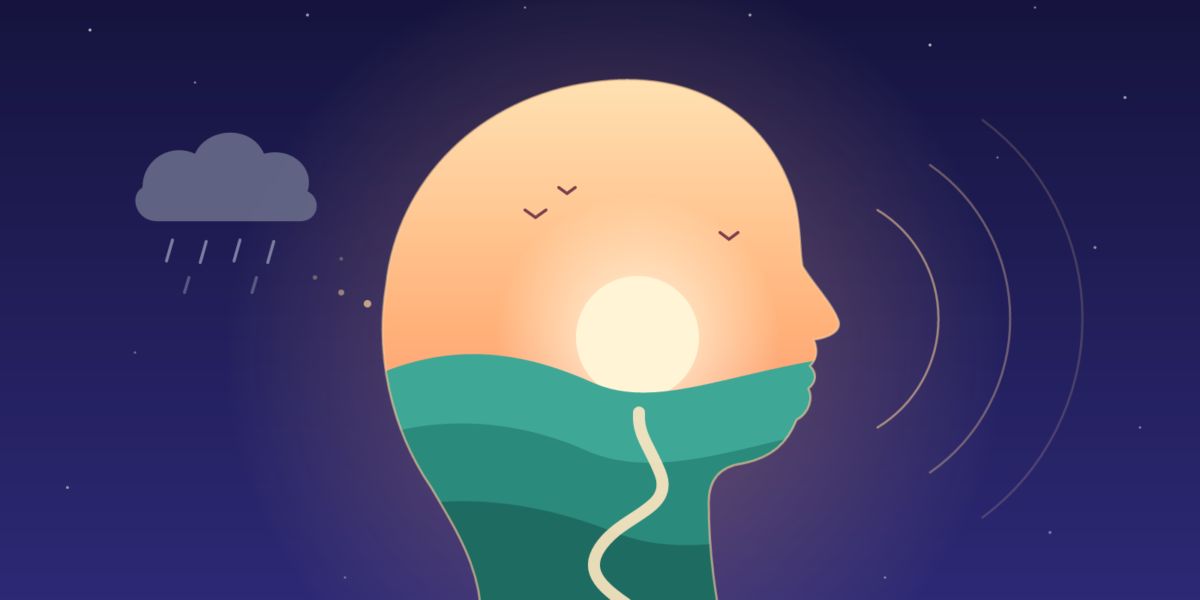
Your beliefs shape your reality by deciding what your brain notices, how your nervous system reacts, and what you dare to do. Your brain treats a belief as a prediction and prepares your body for it, which changes your stress hormones, your pain and your performance. Over months, those small changes in action build a different life.
This guide shows how beliefs shape your reality step by step, with real research, everyday examples from India and America, honest limits, and a practical 21-day plan to rewrite the beliefs that hold you back.
Key takeaways
- A belief is a prediction your brain uses as a shortcut, and it filters what you see.
- Your nervous system turns beliefs into biology: heart rate, hormones, pain and focus.
- Studies link beliefs to longer life, less pain and better exam scores, but belief is not magic and never replaces medical care.
- Traditional beliefs, from karma to the American Dream, can either fuel effort or quietly limit it.
- You can rewrite a belief by catching it, calming the body, testing it and proving a new one through small actions.
Two people, one situation, two different lives
Picture two 17-year-olds in Kota, Rajasthan. Both score 92 out of 300 on the same JEE mock test. Riya thinks, “I am just not a maths person. My cousin was right.” Arjun thinks, “92 is my starting point. Now I know exactly which chapters are weak.”
Same score, same city, same coaching centre. But watch what happens next.
Riya’s body treats the result as a threat. Her heart races every time she opens the physics book, so she opens it less. When she gets a question wrong in class, she reads it as proof. Her teacher, sensing her withdrawal, calls on her less often. Six months later, her belief looks like a fact.
Arjun’s body treats the same result as a challenge. He feels nervous too, but he reads the nervousness as fuel. He asks more questions, so the teacher gives him more attention. Six months later, his belief also looks like a fact.
Now move to Columbus, Ohio. Two warehouse supervisors, Mike and Dana, are laid off in the same round of automation cuts. Mike tells himself, “At 48, nobody hires guys like me. The system is rigged.” Dana tells herself, “This is awful, and I have skills somebody needs.” Mike stops applying after three rejections. Dana sends forty applications, takes a short certification course, and is hired as a logistics coordinator four months later.
Neither of them was simply right or wrong about the job market. Each belief set off a chain of actions, and the chain built the outcome.
One promise before we begin. This is not a “think positive and the universe will deliver” guide. Belief has real power, and it also has real limits. You will get both, because a belief built on honesty lasts longer than one built on hype.
What a belief really is: a prediction, not an opinion
A belief is your brain’s best guess about how the world works, stored so it can act fast without thinking. “Dogs bite.” “Rich people are greedy.” “I always mess up interviews.” “Hard work pays.” Each one is a shortcut that tells you what to expect and how to respond.
That makes beliefs useful. You cannot calculate from zero whether every staircase will hold you. You believe it will, and you walk. The problem starts when a shortcut built for one situation keeps running in places where it no longer fits.
Four places beliefs come from
- Family and early childhood. What you heard at the dinner table before age 10 often becomes the voice in your head at 40. “Paisa ped pe nahi ugta” (money doesn’t grow on trees) can teach thrift, or it can teach that money is always scarce.
- Culture and religion. Ideas about karma, fate, luck, gender roles and success arrive with your community, often without anyone saying them out loud.
- Personal experience. One humiliation in a school play can become “I can’t speak in public.” One early win can become “I’m good under pressure.”
- Repetition and media. Whatever you hear often starts to feel true. Psychologists call this the illusory truth effect, and social media feeds run on it.
The filter you never notice
Your brain receives far more information than it can process. So it filters, and beliefs decide the filter. If you believe your boss dislikes you, you will notice her short email and miss her thank-you in the meeting. This is confirmation bias, one of the cognitive biases that quietly distort everyday decisions.
Try this right now. Look around the room and count everything that is blue. Now close your eyes and name everything that was red. Most people can name very little. The red was there all along. You simply were not looking for it. Your beliefs work the same way, all day long.
The belief loop
The most important idea in this guide is that beliefs are self-reinforcing. They work in a loop:
- Belief: “I’m bad with money.”
- Perception: You notice every overspend and ignore the months you saved.
- Feeling: Opening your bank app brings dread.
- Action: So you avoid checking it.
- Result: Bills get missed and fees pile up.
- Evidence: “See? I’m bad with money.”
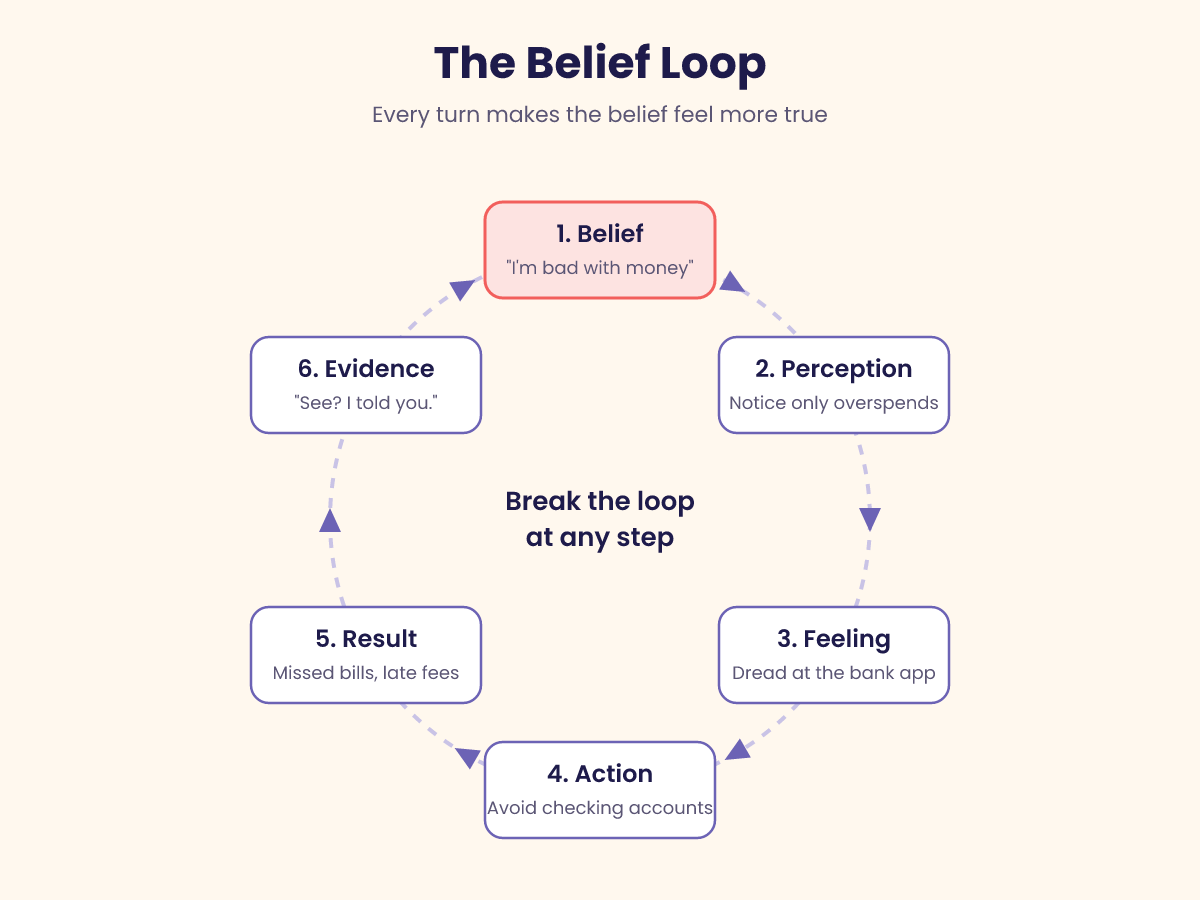
The loop does not care whether the starting belief was true. It only cares that you keep feeding it. The good news is that the same loop runs in the positive direction, and you can break in at any point: the belief, the perception, the feeling or the action.
How beliefs shape your reality through the nervous system
A belief is not just a thought sitting in your head. Your nervous system reads it as a forecast and prepares your whole body for the future it predicts. That is why a belief can change your heartbeat, your hormones and even your pain.
Your brain is a prediction machine
Neuroscientists increasingly describe the brain as a prediction engine. It does not wait for the world to arrive and then react. It constantly guesses what is about to happen, then checks the guess against incoming signals from your eyes, ears and body.
When the guess is strong, it wins. That is why a rope on a dark path can make your heart jump before you realise it is not a snake. Your brain predicted “snake,” and your body acted on the prediction. Beliefs are simply your brain’s longest-running predictions, so they shape what you experience before you have a chance to think.
The two gears: accelerator and brake
Your autonomic nervous system runs without conscious control. It has two main branches:
- The sympathetic branch (accelerator). It speeds up your heart, sharpens attention and releases adrenaline and cortisol. It is the fight-or-flight system.
- The parasympathetic branch (brake). Led largely by the vagus nerve, it slows the heart, supports digestion and helps you recover. It is the rest-and-digest system.
Neither gear is good or bad. You need the accelerator to catch a bus or give a speech. Trouble starts when a belief keeps your foot pressed on it all day. “My job could go any moment.” “People are judging me.” “Something bad is coming.” Each one tells the body to stay on alert, and a body on permanent alert sleeps worse, digests worse and heals slower.
Threat or challenge: same heartbeat, different body
When you face pressure, your body enters one of two broad states, depending on how you read the situation.
- Threat state. You believe the demands are bigger than your resources. Blood vessels tighten, the heart works harder for less output, and thinking narrows.
- Challenge state. You believe you have enough resources to cope. The heart still pumps hard, but blood vessels open up, more oxygen reaches the brain and muscles, and performance tends to improve.
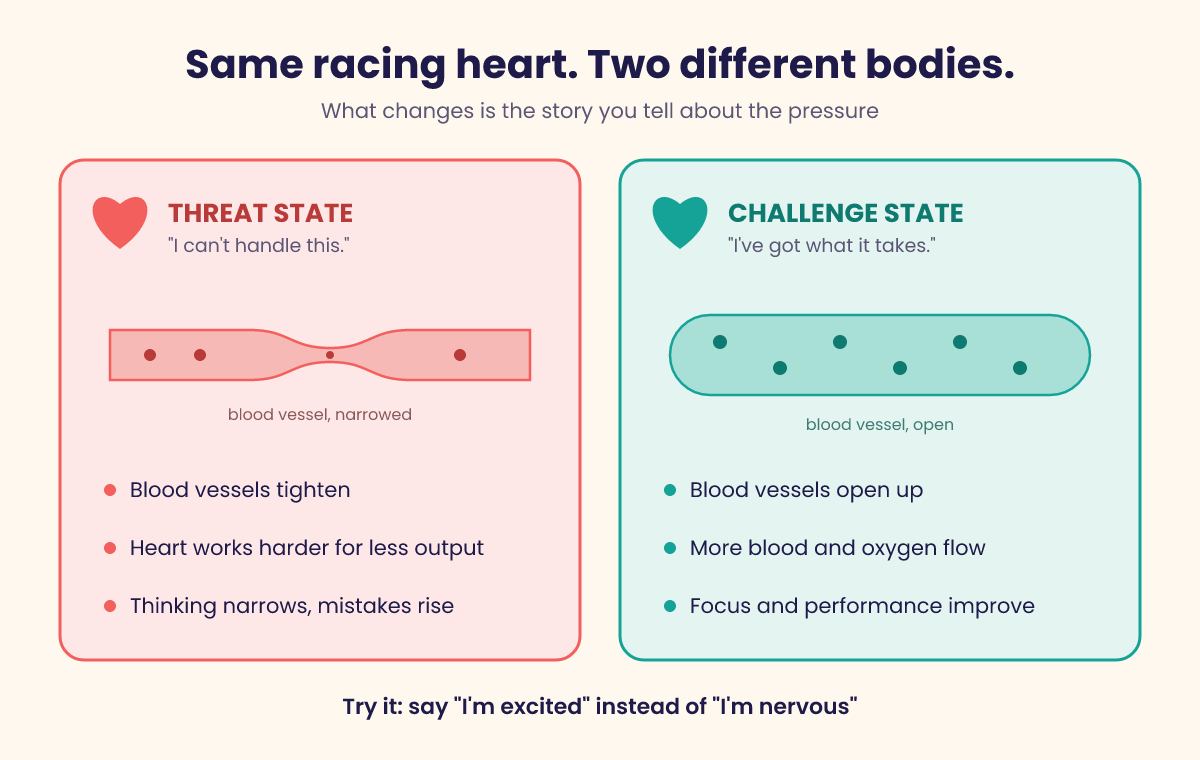
Your heart races in both states. The difference is the story you attach to the racing. That is why the line “I’m not nervous, I’m excited” is more than a pep talk. It nudges the body toward the challenge pattern.
Placebo and nocebo: belief as medicine and poison
The placebo effect is the clearest proof that belief reaches into biology. Back in 1978, researchers found that a drug which blocks the body’s natural opioids also blocked placebo pain relief. In other words, believing you had taken a painkiller made your brain release its own painkillers.
The reverse is called the nocebo effect. Expect harm, and you can feel harm. Read a long list of side effects, and you may develop several of them, even from a sugar pill.
Calming the system through the body
Because the nervous system runs in both directions, you can also influence beliefs from the body upward. Slow breathing with a longer exhale activates the brake. Many Indian families already know this through pranayama practices such as Bhramari (humming bee breath) and Anulom Vilom.
A simple version anyone can use: breathe in through the nose, take a second short sip of air at the top, then exhale slowly through the mouth. Repeat for two to five minutes. Researchers call this a physiological or cyclic sigh, and a Stanford study found daily practice improved mood.
A calm body makes it easier to question a scary belief. A panicking body will defend almost any belief that kept it alive before.
A note on popular theories: you may hear about polyvagal theory on social media. It has helped many therapists and clients talk about safety and the body, but several of its specific scientific claims are disputed. The practical lesson still holds: feeling safe in the body makes change easier.
The evidence: seven real studies that show belief changing the body
The claim that belief changes reality gets thrown around loosely. So here are seven real experiments and long-term studies, what they found, and what they mean for your life.
1. The hotel housekeepers who got fitter without changing anything
In 2007, Harvard psychologists Alia Crum and Ellen Langer studied 84 hotel room attendants across seven hotels. Most did not think of themselves as exercising, even though cleaning about 15 rooms a day is hard physical work. One group was told, with examples, that their daily work already met the official guidelines for an active lifestyle. The other group was told nothing.
Four weeks later, the informed group showed lower weight, blood pressure, body fat and BMI than the control group. Their workload, according to managers, had not changed. Press coverage reported an average drop of about 10 points in systolic blood pressure. (source)
The lesson: How you label your effort may affect how much benefit you get from it. A homemaker in Pune climbing stairs with groceries all day is exercising, whether she calls it that or not.
2. Two milkshakes that were secretly the same
At Yale, 46 people drank a 380-calorie milkshake on two occasions. Once it was labelled a 620-calorie “indulgent” shake, once a 140-calorie “sensible” shake. When people believed they were drinking the indulgent shake, levels of ghrelin, the hunger hormone, dropped much more steeply. When they believed it was the diet shake, ghrelin stayed fairly flat. (source)
The lesson: Your gut responds partly to what you believe you ate. Eating diet food with a feeling of deprivation may leave your body less satisfied.
3. Stress only became deadly when people believed it was
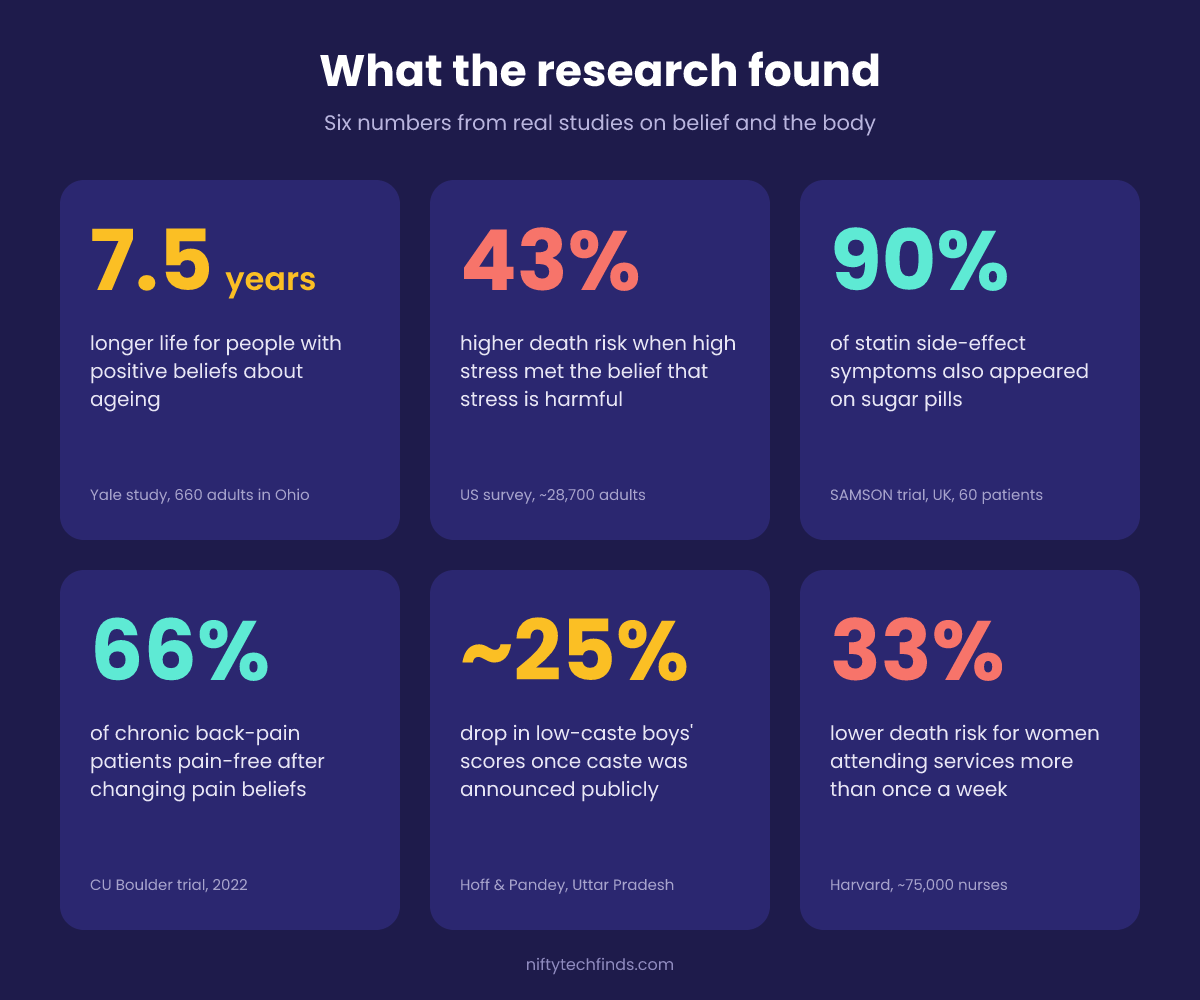
Researchers linked survey answers from about 28,700 American adults to death records over eight years. People who reported a lot of stress and believed stress was badly harming their health had a 43% higher risk of premature death. People with high stress who did not hold that belief had among the lowest death risk in the study. (source)
The lesson: Stress is not the whole problem. Your belief about stress shapes how your body responds to it. This study is observational, so it cannot prove cause, but it fits the threat-versus-challenge research above.
4. Seven and a half extra years from a view on ageing
Yale’s Becca Levy followed 660 adults aged 50 and older in a small Ohio town for up to 23 years. Those with more positive beliefs about ageing lived about 7.5 years longer than those with negative beliefs, after accounting for age, sex, income, loneliness and health. That gap was larger than the gains linked to low blood pressure or low cholesterol. (source)
The lesson: “Budhapa toh bimari hai” (old age is a disease) and “I’m too old for this” are not harmless jokes. They may quietly shape how you age.
5. Statin side effects that came mostly from the bottle
In the SAMSON trial, 60 British patients who had quit cholesterol-lowering statins because of side effects took a year of rotating statin pills, sugar pills and no pills, without knowing which was which. About 90% of the symptoms they felt on statins also showed up on the sugar pills. (source)
The lesson: The pain was real. Its main cause was the expectation of pain. Six months later, about half of the patients had gone back on statins.
6. Sugar pills that worked even when patients knew
In a 2010 Harvard trial, 80 people with irritable bowel syndrome were openly told they were getting sugar pills with no medicine inside. They still reported significantly greater relief than a group given the same caring attention but no pills. (source)
The lesson: Ritual, care and expectation carry healing power on their own. This is one reason prayer, a trusted doctor or a daily routine can help, alongside real treatment.
7. Students who were told nerves help them scored higher
In a 2010 study, students preparing for the GRE graduate exam were told that feeling anxious and aroused can actually improve performance. They outperformed a control group on the practice maths section and again on their real GRE taken one to three months later. (source)
The lesson: Before a board exam, interview or match, do not try to get rid of the butterflies. Tell yourself they are your body getting ready.
Traditional beliefs in India: what they give and what they cost
Indian life is rich with inherited beliefs, from astrology and auspicious timings to sayings about fate and family honour. Many carry real wisdom. Some quietly limit people. The point here is not to mock tradition but to see clearly what each belief does to perception and action.
Caste and the boys who solved fewer mazes
This is one of the most powerful belief experiments ever run in India. Economists Karla Hoff and Priyanka Pandey asked several hundred school-age boys in rural Uttar Pradesh to solve mazes for small cash rewards. When nobody’s caste was announced, high-caste and low-caste boys performed about the same. When each boy’s caste was read out publicly, low-caste boys’ performance dropped by around 25%. (source)
The boys had the same ability one minute earlier. What changed was the belief, triggered by a public reminder, that the system would judge them unfairly. The researchers found the gap appeared mainly when rewards depended on someone’s judgement, not when the payout was purely mechanical.
Why it matters to you: Whatever label you grew up under, caste, a “backward” district, Hindi-medium, small town, can drain performance the moment it is made visible. Knowing this is half the defence.
“Log kya kahenge” (what will people say?)
Few beliefs shape Indian choices more. It decides careers (“engineering or medicine, nothing else”), marriages, whether someone seeks therapy, and whether a 35-year-old dares to start a business.
The perception effect is huge. A person ruled by this belief scans every room for disapproval and finds it, because the brain finds what it looks for. The cost is a life built for an imaginary audience. Most “log” are busy worrying about what others say about them.
Karma and kismat: resilience or resignation?
The same tradition can produce opposite outcomes, depending on how it is held.
- Held as fatalism: “Kismat mein nahi tha” (it wasn’t in my fate) can end effort after one failed attempt.
- Held as the Gita teaches: Krishna’s advice to act fully without attachment to the fruits of action is one of the best performance-anxiety tools ever written. It shifts attention from the result you cannot control to the effort you can. That is very close to what sports psychologists teach today, and it echoes the types of intelligence described in Indian wisdom traditions.
- “Jo hota hai, achhe ke liye hota hai” (whatever happens, happens for good) can be a healthy reframe that helps people recover from loss, as long as it does not become an excuse to stay silent about real injustice.
Kundali, Mangal dosha and the expectation of conflict
Millions of families check horoscope compatibility before marriage. Whatever one thinks of astrology, the belief itself has effects. A person told they are “Manglik” may face rejections, delays and years of anxiety. A couple told their charts clash may start reading every normal argument as proof of doom, which is the belief loop in action.
The flip side is also real. A couple told their match is excellent may enter marriage with more patience and goodwill. The stars did not change anything. The expectation changed how they treated each other.
Nazar, nimbu-mirchi and the ritual that calms
A lemon and seven chillies over a shop door, a black dot behind a baby’s ear. Rituals like these often reduce anxiety by giving people a sense of control, much like the open-label placebo study above.
The hidden cost comes when fear of nazar (the evil eye) stops people from sharing good news, celebrating success or asking for help. A belief that teaches “hide your wins” can also teach “don’t aim too high.”
Fasting with meaning
During Navratri, Ramzan, Karva Chauth or Ekadashi, many people go without food for long hours with surprising ease, yet struggle to skip a single snack on an ordinary diet. The difference is belief and meaning. When the brain believes hunger serves a purpose, it reads hunger as a challenge, not a threat.
Sharma ji ka beta and the comparison trap
Endless comparison with the neighbour’s son who topped JEE teaches children one belief: “I am only worth my rank.” It can push some to excel, but it trains the nervous system to treat every test as a threat to their worth, and that threat state makes clear thinking harder exactly when it is needed.
When India changed its belief about itself
Belief also works at the level of a nation. Before 1983, few thought India could win a cricket World Cup. After Kapil Dev’s team beat the West Indies at Lord’s, a generation grew up believing it could. In January 2021, an injury-hit Indian side full of young players won at Brisbane’s Gabba, a ground where Australia had not lost a Test in over three decades.
The same is true in science. Women such as Ritu Karidhal and Muthayya Vanitha led India’s Chandrayaan-2 mission, quietly breaking the old belief that girls are not built for maths and engineering. Every visible example rewrites the belief for millions of watching children.
Traditional beliefs in America: the same forces, different costumes
America likes to think of itself as rational and modern, but its beliefs run just as deep. They simply wear different clothes: self-reliance, the American Dream, sports superstitions, medical expectations and church community.
Chinese Americans and the “ill-fated” birth year
In a 1993 study published in The Lancet, sociologist David Phillips examined tens of thousands of death records of Chinese Americans. Traditional Chinese astrology links certain birth years with weakness in particular organs. Chinese Americans who had both an “ill-fated” birth year and the matching disease died earlier, by up to about five years, than those with the same disease and a different birth year. White Americans with the same combinations showed no such pattern, and the effect was stronger among people more attached to tradition.
Treat this with care. It is observational, and a later study by the same team on the unlucky number four failed to replicate in independent checks. (source) But it raises a sobering possibility: when a belief tells you a disease is your destiny, you may fight it less.
Chronic back pain that disappeared when the belief changed
In a 2022 trial at the University of Colorado Boulder, 151 adults with long-term back pain were split into three groups. One group had four weeks of Pain Reprocessing Therapy, which teaches people that their pain is a real but non-dangerous signal from an over-protective brain, not proof of damage.
After treatment, 66% of that group were pain-free or nearly pain-free, compared with 20% given a placebo injection and 10% on usual care. Most of the benefit lasted a year. (source)
The lesson: For many people, the belief “my back is broken” keeps the alarm ringing. This does not mean pain is imaginary or that every pain is the same, so get a proper medical check first.
Church, community and a third lower death risk
A Harvard study followed nearly 75,000 American nurses for about 16 years. Women who attended religious services more than once a week had a 33% lower risk of dying during the study than those who never attended. The researchers credited social support, less smoking, less depression and more optimism. (source)
The same logic applies to the Sunday gurdwara langar, the Friday namaz or the evening aarti at a local mandir. Shared belief, shared meals and a sense of belonging protect the nervous system.
The American Dream: fuel and trap
“Anyone can make it if they work hard enough” is a belief that has pulled millions of immigrants, including Indian engineers, doctors and motel owners, toward remarkable effort. It turns setbacks into temporary obstacles.
Its dark side is shame. When someone works hard and still loses a job to automation or medical debt, the belief whispers, “Then it must be your fault.” The healthiest version keeps the effort and drops the blame: “My effort matters, and so do the conditions around me.”
Sports superstitions and pre-game rituals
Michael Jordan famously wore his old University of North Carolina shorts under his Chicago Bulls uniform. Baseball players avoid stepping on foul lines. Football fans wear the same unwashed jersey through a winning streak.
The lucky shorts do nothing to the ball. But a fixed ritual can calm the body and focus attention, nudging an athlete toward the challenge state. The risk comes when the ritual becomes the belief: “If I forget my lucky socks, I’ll lose.” Then the same belief that calmed you can sink you.
Teacher expectations and the Pygmalion effect
In a famous 1960s experiment in a California elementary school, Robert Rosenthal and Lenore Jacobson told teachers that certain randomly chosen students were about to “bloom” intellectually. Some of those children, especially younger ones, later showed IQ gains. Later research found the effect is real but usually smaller than the original headlines suggested. Teachers who expect more tend to give more warmth, more feedback and more chances to answer.
The Indian version plays out daily in classrooms where the “bright” first-bench students get the questions and the backbenchers get ignored. Expectation becomes attention, and attention becomes results.
Side-effect lists in drug ads
American TV drug commercials famously end with a fast-spoken list of possible side effects. Combined with the SAMSON findings, this suggests a real cost: telling people exactly what to fear can make them feel it. Doctors increasingly frame side effects in more balanced ways, such as stating how many people on a sugar pill reported the same symptom.
How beliefs change situations, not just feelings
So far we have looked at how belief changes what happens inside you. The bigger effect is outside: your belief changes your behaviour, your behaviour changes how others respond, and their response changes your situation. Sociologist Robert Merton named this the self-fulfilling prophecy in 1948.
The bank that collapsed because people believed it would
Merton’s classic example was a perfectly healthy bank. A rumour spreads that it is in trouble. Worried customers rush to withdraw their money. Because no bank keeps all deposits in cash, the rush itself makes the bank fail. The false belief became true because people acted on it.
This is not ancient history. Rumours on WhatsApp or X can trigger queues outside a branch within hours. In March 2023, Silicon Valley Bank in California saw tens of billions of dollars in withdrawal requests in about a day as fear spread online. Markets, currencies and even onion prices often move on what people believe will happen.
The same pattern in everyday life
| Belief | What you do | How others respond | The situation you end up in |
|---|---|---|---|
| “People always leave me.” | Get clingy or test your partner constantly | Partner feels suffocated and pulls away | You are left, again |
| “I’m not a leader.” | Stay quiet in meetings, avoid volunteering | Manager stops thinking of you for bigger roles | You are passed over for promotion |
| “My in-laws will never accept me.” | Stay guarded, read neutral comments as insults | They sense coldness and become cooler too | Relations stay tense for years |
| “Clients don’t pay for quality.” | Underprice your work and pitch weakly | Clients treat you as a cheap vendor | You stay stuck in low-paying work |
| “I’ll recover from this injury.” | Do your physiotherapy exercises every day | Doctors and family keep encouraging you | You recover faster |
Notice that the last row runs the other way. Self-fulfilling prophecies are neutral machines. They manufacture whatever you feed them.
Why others can feel your belief
People read tiny signals within seconds: eye contact, tone, posture, how quickly you reply. An interviewee who believes “they’ll never hire someone from a tier-3 college” walks in with slightly lowered eyes and shorter answers. The interviewer, without knowing why, rates them as less confident. Neither person is lying. The belief simply leaked out through the body.
The cultural multiplier
When a whole community shares a belief, its effect multiplies. If a village believes girls should stop studying after Class 10, few families invest in a daughter’s education, so few women become role models, which seems to confirm the belief. The caste maze study showed the same pattern in a single afternoon.
The hopeful flip side: one visible exception can start to crack a shared belief. That is why every first-generation graduate, every woman pilot from a small town and every comeback story matters far beyond one life.
Where belief stops: the honest limits
Belief is powerful, but it is not magic. A guide that skips the limits sets people up for disappointment, or worse, for blaming themselves when life goes wrong. Keep these six truths alongside everything above.
- Belief works best on what the brain controls. Placebo and mindset effects are strongest for pain, fatigue, nausea, anxiety, motivation and performance. They do not shrink tumours, kill bacteria or replace insulin. Never stop a prescribed medicine because you have decided to think yourself well. Talk to your doctor, whichever healing system you trust.
- Manifesting is not a strategy. Popular ideas like the law of attraction claim that thinking about money or a dream partner will draw them to you. There is no good evidence for that. Research by psychologist Gabriele Oettingen suggests pure positive fantasising can even reduce effort, because the brain partly tastes the reward in advance. Belief helps when it drives action, not when it replaces action.
- Overconfidence is also a belief, and it is expensive. In a well-known study of tens of thousands of US brokerage accounts, economists Brad Barber and Terrance Odean found that investors who traded most often earned noticeably lower returns. Healthy belief is confident about effort and humble about outcomes.
- Some famous findings have shrunk. The idea that a two-minute power pose changes your hormones did not replicate well. Stereotype threat effects appear real but smaller than early studies claimed. The legend that nobody believed a four-minute mile was possible until Roger Bannister ran it in 1954 is exaggerated; several runners were already close.
- Structure is real. Belief cannot erase caste discrimination, racism, poverty, a bad boss or a broken health system. The caste maze study shows belief and discrimination working together. Changing your belief is one lever. Changing the conditions around you is another, and both matter.
- Never blame the sick for their thoughts. If someone gets ill, it is not because they weren’t positive enough. That idea is cruel and false. Use this knowledge to support people, not to judge them.
The goal is not blind optimism. It is accurate, useful belief: seeing the situation clearly while choosing the interpretation that gives you the most room to act.
How to find and rewrite a limiting belief in 8 steps
You cannot rewrite a belief by shouting affirmations at the mirror. The brain rejects statements it finds unbelievable. What works is a slower, more honest process: catch the belief, calm the body, test the belief, then prove a new one through small actions.
Step 1: Catch the belief in the act
Beliefs hide behind emotions. Whenever you feel a sudden spike of dread, anger, shame or hopelessness, pause and ask: “What am I assuming right now?”
Then dig one level deeper with the “and that means” question, a technique cognitive behavioural therapists call the downward arrow.
- “My boss didn’t reply to my email.” And that means…
- “She’s unhappy with my work.” And that means…
- “I’ll be the first one let go.” And that means…
- “I’m never good enough.” That is the core belief.
Step 2: Write it down in one plain sentence
A belief in your head feels like reality. On paper, it looks like what it is: a sentence someone wrote. “I’m never good enough” seems far less certain once you see it written in your own handwriting.
Step 3: Ask whose voice it is
Most limiting beliefs were installed by someone else. A strict father, a sarcastic teacher, a relative at a wedding, an ex-partner. Ask: “When did I first hear this? Who said it?” A belief you borrowed at age eight does not deserve a lifetime lease.
Step 4: Calm the body before you argue with the mind
You cannot reason well while your nervous system is in threat mode. Before testing the belief, do two to five minutes of slow breathing with long exhales, or walk for ten minutes. Then return to the page.
Step 5: Put the belief on trial
Treat yourself like a fair judge, not a prosecutor. Make two columns:
- Evidence for the belief (real facts, not feelings)
- Evidence against the belief (times it was not true, people who would disagree, exceptions)
Then rate how strongly you believe it from 0% to 100%. Most people find their absolute truth drops to something like 60% after an honest trial. That gap is where change begins.
Step 6: Write a believable bridge belief
Do not jump from “I’m terrible with money” to “I’m a financial genius.” Your brain will reject it. Write a bridge belief, a statement that is true now and points in the right direction:
- “I’m learning to handle money better, one month at a time.”
- “I’ve handled hard situations before, so I can learn to handle this.”
- “I’m not fluent yet, and I’m improving every week.”
The word “yet” is one of the most useful tools in this guide. “I can’t do maths” closes a door. “I can’t do maths yet” opens one.
Step 7: Run a small experiment
Action changes belief faster than words. Psychologists have long found that people infer their beliefs partly from watching their own behaviour. So design one small, low-risk experiment that the new belief would predict:
- If you believe “I can’t speak up,” ask one question in the next team meeting.
- If you believe “Nobody wants to hear from me,” message one old friend today.
- If you believe “I’m too old to learn tech,” finish one free beginner lesson this week.
Write down what you predicted would happen and what actually happened. The gap between the two is new evidence your brain cannot ignore.
Step 8: Change your inputs
Beliefs are fed daily by the people you spend time with, the content you scroll and the stories you repeat. Curate them deliberately:
- Follow people who are one or two steps ahead of you, not ten. Close role models feel achievable.
- Notice the phrases you repeat. Swap “I have to” for “I get to,” and “I’m nervous” for “I’m getting ready.”
- Spend less time with people who need you to stay small. You do not need to cut them off, only to stop treating their opinion as the final word.
Two worked examples
Meera, 29, Bengaluru. Core belief: “My English isn’t good enough for client calls, people will laugh.” Origin: being mocked in an English-medium college as a Kannada-medium student. Trial: she has handled 40 written client emails without complaint; her manager praised her clarity. Rating drops from 90% to 55%. Bridge belief: “Clients care about my solutions more than my accent, and my spoken English improves with practice.” Experiment: she speaks for two minutes in one call per week. Within two months, she volunteers to lead a client demo.
Jake, 46, Houston. Core belief: “I’m too old to switch from oil-field work to anything else.” Origin: his father’s view that you stick with one job for life. Trial: he finds three colleagues over 45 who moved into solar installation and safety training. Rating drops from 85% to 50%. Bridge belief: “My field experience is an asset in energy jobs, and I can learn the new parts.” Experiment: one informational call per week with someone in solar. Four months later, he enrols in a certification course with his employer’s partial funding.
Your 21-day belief reset plan
Knowing all this changes nothing until you practise it. This plan takes about 15 minutes a day for three weeks and works on one belief at a time. Pick the belief that costs you the most, whether in health, money, relationships or career.
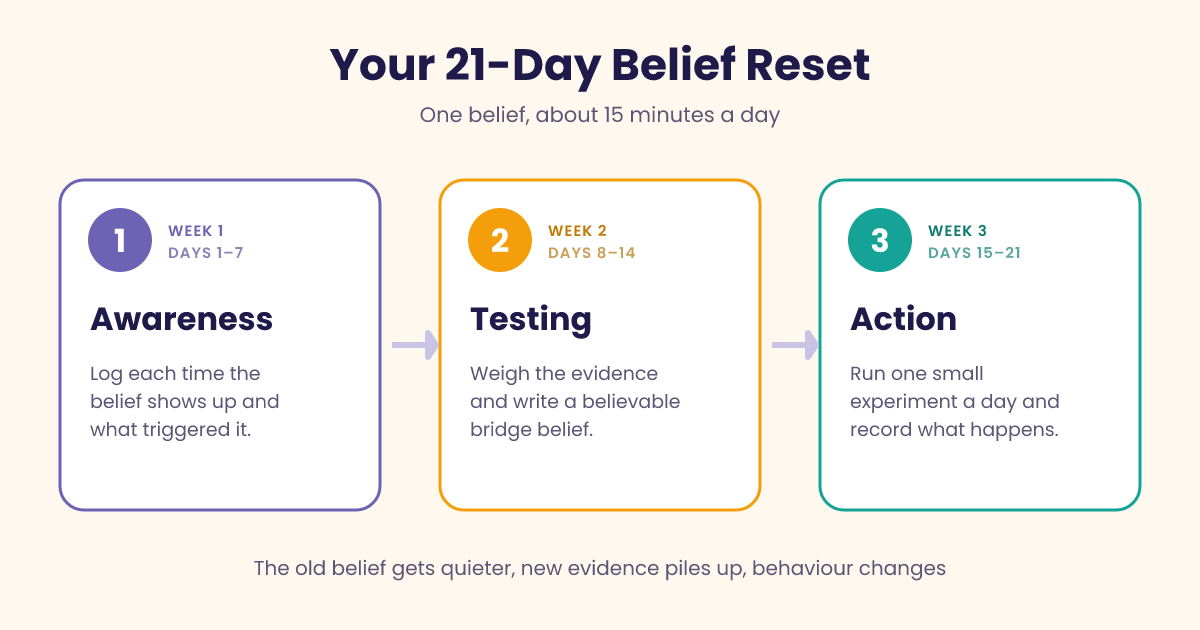
| Week | Focus | Daily practice (about 15 minutes) | What you should notice by the end |
|---|---|---|---|
| 1 (Days 1 to 7) | Awareness | Log every moment the belief shows up: the trigger, the thought, the body feeling and what you did next. End with 3 minutes of slow-exhale breathing. | The belief appears in more places than you thought, and it follows a pattern. |
| 2 (Days 8 to 14) | Testing | Run Steps 3 to 6 once on Day 8. Each day after, write one piece of evidence against the old belief and read your bridge belief aloud twice. | Your confidence in the old belief drops, often by 20 to 40 points. |
| 3 (Days 15 to 21) | Action | Do one small experiment each day that the bridge belief predicts. Record what you expected versus what happened. | You have 7 real pieces of new evidence and your behaviour has started to change. |
Your daily checklist
- Morning: read your bridge belief aloud and say one thing you are getting ready for today.
- When a strong emotion hits: pause and ask, “What am I assuming right now?”
- Before a stressful moment: tell yourself, “This energy is my body getting ready.”
- Evening: write one piece of evidence against the old belief.
- Evening: 3 minutes of slow breathing with long exhales.
Tips that make it stick
- Do it with someone. A friend, spouse or sibling running the same plan makes you far more likely to finish. In joint families, this can become an evening ritual.
- Expect bad days. On Day 9 the old belief may come back louder. That is normal. Old pathways are well worn. Log it and continue.
- Repeat with a new belief. After 21 days, pick the next belief. Most people find each round gets faster, because the first win weakens the master belief underneath: “I can’t change.”
- Get professional help when needed. If a belief is tied to trauma, persistent depression or anxiety that disrupts daily life, a qualified therapist can help far more than any article. In India, the government’s free Tele-MANAS helpline (14416) is available around the clock. In the US, you can call or text 988 for mental-health support.
Conclusion: you are not your beliefs, you are the one holding them
Go back to Riya and Arjun in Kota, and Mike and Dana in Ohio. None of them chose their first reaction. Beliefs installed by family, culture and experience fired automatically. But each of them could choose what happened next: which evidence to collect, which story to tell the racing heart, and which small action to take on Monday morning.
That is the real message of this guide. Your nervous system will always predict, your culture will always hand you stories, and some of those stories will be wrong. You do not need to believe every thought you think. You can catch a belief, question it kindly, test it honestly, and replace it with one that gives you more room to live.
Start with one belief. Give it 21 days. Then watch what changes, first in how you see things, then in how you feel, and finally in the situation itself.
Frequently asked questions
How do beliefs shape your reality?
Beliefs act as predictions. They decide what your brain notices, how your nervous system reacts, and what actions you take. Over time, those actions change how others respond to you and the situations you end up in.
Can changing my beliefs really change my health?
For some outcomes, yes. Studies show beliefs affect pain, stress hormones, hunger hormones, blood pressure and even long-term survival. But belief is not a replacement for medical treatment, so use it alongside proper care.
Is this the same as the law of attraction?
No. The law of attraction claims thoughts pull outcomes toward you. The research shows something different: beliefs change your body’s responses and your behaviour, and those changes affect outcomes.
Should I give up traditional beliefs like astrology or nazar?
Not necessarily. Ask what each belief does for you. If a ritual calms you and helps you act with confidence, it may be serving you. If it makes you avoid opportunities or fear people, it is worth questioning.
How long does it take to change a deep belief?
Small beliefs can shift in days. Core beliefs about worth or safety can take months of repeated evidence. Progress usually looks like the belief getting quieter, not vanishing overnight.
What is the fastest technique to change how I feel under pressure?
Reframe nervousness as readiness. Before an exam, interview or difficult talk, tell yourself, This is my body getting ready. Research suggests it can shift your body toward the challenge state within minutes.
Sources
- Crum and Langer (2007), hotel room attendants and exercise mindset: Harvard DASH
- Crum et al. (2011), Mind over milkshakes: Yale News
- Keller et al. (2012), stress perception and mortality: PubMed
- Levy et al. (2002), self-perceptions of ageing and longevity: American Psychological Association
- SAMSON trial (2020), statins and the nocebo effect: TCTMD
- Kaptchuk et al. (2010), open-label placebo for IBS: Harvard DASH
- Jamieson et al. (2010), reappraising arousal and GRE scores: Harvard DASH
- Hoff and Pandey, caste identity and maze performance: World Bank Open Knowledge
- Phillips studies on Chinese American mortality and their replication problems: McGill Office for Science and Society
- Ashar et al. (2022), Pain Reprocessing Therapy for chronic back pain: CU Boulder Today
- Li, VanderWeele et al. (2016), religious service attendance and mortality: Harvard T.H. Chan School of Public Health