
Last updated: October 22, 2026. Covers announcements from October 1 to 22.
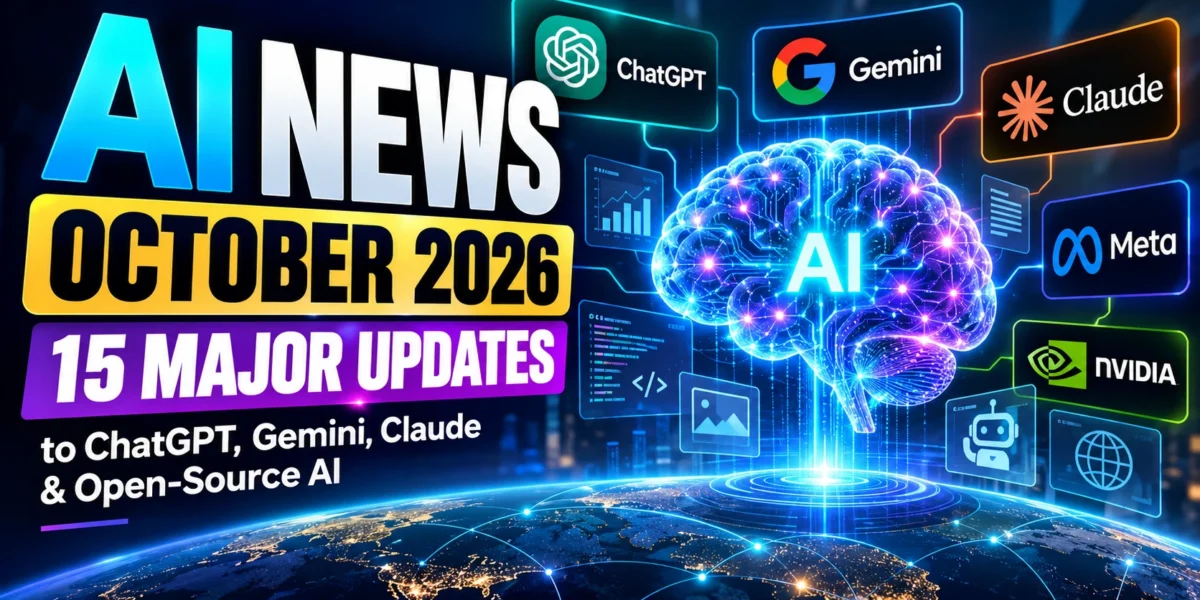
The biggest AI news of October 2026 so far: OpenAI put GPT-6 in front of every ChatGPT user, Google opened Gemini 4 Argon to paying subscribers, Anthropic launched its cheapest model yet (Claude Haiku 5.5), and Meta entered the frontier race with Muse Wonder. The most urgent story, though, is a critical PHP security flaw found with AI help, which affects many WordPress sites and needs patching now.
Below are the 15 developments that matter most, each with what happened, why it matters in plain English, and a link to the source.
Key takeaways
- Run a WordPress or PHP site? Update PHP today. Two critical flaws (rated 9.2 out of 10) were patched on October 21.
- ChatGPT answers are now interactive. GPT-6 brings charts, buttons and mini-tools into replies, including on the free plan.
- Cheap AI got much cheaper. Claude Haiku 5.5 costs about 75% less to run than Haiku 4.5, according to Anthropic.
- Agents are going to work. Google, NVIDIA and others focused on AI agents that complete multi-step jobs, plus the guardrails to keep them in check.
- Ads are spreading inside AI. ChatGPT ads now run in 89 countries on the Free and Go plans.
AI news October 2026 at a glance
| Date | Company | Update | Who should care |
|---|---|---|---|
| Oct 7 | OpenAI | GPT-6 and Intelligent UI for all ChatGPT users | Everyone |
| Oct 7 | Anthropic | Claude Haiku 5.5 | Developers, businesses |
| Oct 8 | Google Cloud | Gemini agent for work | Businesses |
| Oct 8 | Anthropic | Cyber Mission and free OSS Scanner | Open-source maintainers |
| Oct 12 | Meta | Muse Wonder and Muse Wonder Full | Developers |
| Oct 13 | Gemini 4 Argon in the Gemini app | Gemini subscribers | |
| Oct 14 | YouTube | Labels for AI-generated music | Listeners, creators |
| Oct 14 | Anthropic | Singapore office and government MOU | Asia-Pacific businesses |
| Oct 15 | Simons Foundation, OpenAI, Anthropic | $15M to help mathematicians check AI results | Researchers, students |
| Oct 18 | Anthropic | Public Benefit Fund (5% of shares) | Industry watchers |
| Oct 20 | OpenAI | Acquires Orchestra Bio | Life sciences |
| Oct 21 | PHP Foundation, OpenAI and others | Critical PHP flaws patched | Website owners |
| Oct 21 | OpenAI and Google Cloud | OpenAI models coming to Google Cloud | Enterprise developers |
| Oct 21 | OpenAI | ChatGPT ads reach 89 countries | Marketers |
| Oct 21 | NVIDIA | OpenShell Reference Architecture | Agent builders |
Security first: the update every website owner needs
1. AI helped uncover two critical PHP flaws (October 21)
PHP is the programming language behind WordPress and a large share of the web. On October 21 the PHP Foundation released emergency fixes for two flaws, tracked as CVE-2026-109618 and CVE-2026-109619. Both are rated 9.2 out of 10 for severity. They sit in PHP’s core engine, so a site can be exposed even if its own code is perfectly fine, and they can let an attacker run code on a server without logging in.
Security firm Calif found the first flaw in July while using an OpenAI model (GPT-5.6 Sol) as part of OpenAI’s Patch the Planet program, which OpenAI launched with Trail of Bits back in June. Google’s Wiz team independently found related problems, and everyone coordinated the fix over about two months. Details leaked shortly before the planned release, Amazon reported seeing exploit attempts before disclosure, and the US National Security Agency told organisations to patch immediately or take affected systems offline.
What to do: check your PHP version in your hosting control panel and make sure you are on PHP 8.2.35, 8.3.36, 8.4.27 or 8.5.12 (or newer). On shared or managed hosting, ask your host to confirm they have patched. Take a backup first, then update. Sources: Fortune, CNBC.
2. Anthropic launches its Cyber Mission and a free OSS Scanner (October 8)
Anthropic started a long-term security effort with two parts. The Critical Infrastructure Defense Program gives Claude models, on-site engineers and threat research to the firms that protect power grids, water systems and transport networks. Its 11 founding partners include Accenture, CrowdStrike, Deloitte, Palo Alto Networks, PwC and Rockwell Automation.
The second part, OSS Scanner, offers free, regular security scans of open-source projects using Anthropic’s strongest models. It is opt-in and meant for core maintainers of critical projects. Reports arrive without human review, so they are fast but sometimes wrong; Anthropic expects more than 90% of findings to be real. Why it matters: finding bugs is getting easier, but fixing them still depends on stretched volunteer teams. Source: Anthropic. For background, see our explainer on AI cyber models from Google, OpenAI and Anthropic.
New AI models and assistants
3. GPT-6 and Intelligent UI reach every ChatGPT user (October 7)
OpenAI rolled GPT-6 into ChatGPT’s Chat tab with a new answer format called Intelligent UI. Replies can now include interactive charts, diagrams, buttons, forms and small working tools, such as a bill splitter or a savings calculator built on the spot. Simple questions still get plain text, and you can turn the visuals down if you prefer.
Plus, Pro, Business and Enterprise users got it on October 7 using GPT-6 Sol. Free and Go users followed on October 8 with GPT-6 Luna. OpenAI says GPT-6 Instant starts answering web-search questions 44% sooner than GPT-5.6 Instant (a company figure, not an independent test). Why it matters: ChatGPT is shifting from a text box to something closer to a mini-app builder. Source: TechCrunch. New to the GPT-6 family? Read What Is GPT-6 Astra?
4. Anthropic releases Claude Haiku 5.5 (October 7)
Claude Haiku 5.5 is Anthropic’s smallest, fastest and cheapest model, built for high-volume jobs like summaries, classification, customer support, browser use and working as a helper (subagent) for bigger models. For prompts up to 100,000 tokens it costs $0.10 per million input tokens and $0.50 per million output tokens, against $1 and $5 for Haiku 4.5. Anthropic puts the average saving at about 75% once you allow for its new tokenizer using slightly more tokens per task.
It is also the first Haiku model with an adjustable effort setting, so you can trade cost for quality. Alongside it, Anthropic halved Sonnet 5.5’s cache-read price and added monthly API credits for Max ($100 or $200) and Team (up to $500) subscribers. Why it matters: tasks that were too expensive to automate at scale may now be worth it, though Anthropic says Sonnet and Opus remain better for complex coding. Source: Anthropic.
5. Meta enters the frontier race with Muse Wonder (October 12)
Meta released Muse Wonder and Muse Wonder Full, its most capable models so far, aimed at personal and professional agent tasks like understanding a lease, handling an insurance claim or building an app. Two features stand out: Active Memory, which carries important details across conversations, and Active Focus, which keeps the model working through problems and checking in before important actions.
Muse Wonder is available to developers through the Meta Model API and Muse Code, priced at $4 per million input tokens and $20 per million output tokens. Muse Wonder Full is only for Muse Code subscribers. On the independent Artificial Analysis Intelligence Index, Wonder Full scored 56 and Wonder 52, close behind Claude Opus 5.5 at 58. Why it matters: a fourth big lab is now competing at the top, which tends to push prices down. Source: Meta.
6. Gemini 4 Argon arrives in the Gemini app (October 13)
Google first unveiled Gemini 4 Argon on September 30 for a small group of approved cybersecurity defenders. On October 13 it opened more widely: in the Gemini app for Google AI Pro and Ultra subscribers, in the paid Gemini API, and in Google’s Antigravity coding tool for Ultra subscribers. Google says Argon answers more directly, with less hedging and repetition.
The Gemini app also gained a simple switch from chat to tasks, letting Gemini work for you in the background, plus connections to more than 40 apps such as Instacart, OpenTable, Adobe and Shopify. Note: free Gemini users do not get Argon. Source: Google.
AI agents for work
7. Google Cloud introduces the Gemini agent (October 8)
At its Gemini at Work event, Google Cloud launched a single, universal AI agent for businesses. Instead of step-by-step instructions, you give it an objective, and it plans the work, uses tools, connects to company systems and returns finished output inside documents, inboxes and developer tools. It runs in Google’s cloud, so long jobs keep going after you close your laptop, and it works across Google Workspace, Microsoft 365 and Slack.
Google separates the agent from the model underneath, so companies can choose which AI model handles each job, with spending caps and admin controls on top. Why it matters: the big fight in business AI is shifting from which chatbot is smartest to which agent can safely do real work. Source: Google. If agents are new to you, start with What Is Agentic AI?
8. NVIDIA launches the OpenShell Reference Architecture (October 21)
At GTC Berlin, NVIDIA released a blueprint for running AI agents inside strict boundaries. It combines NVIDIA’s open-source OpenShell runtime, which limits what files, networks and credentials an agent can touch, with dedicated hardware that monitors agents and can stop one in milliseconds if it steps outside its limits. Anthropic, OpenAI, Google Cloud, Microsoft, AWS and Meta are among the companies working with it.
Why it matters: agents that can read files and call APIs need guardrails before companies trust them. Small developers do not need NVIDIA hardware to apply the same ideas: least-privilege access, sandboxing, logging and a human approval step for risky actions. Source: NVIDIA.
9. OpenAI models are coming to Google Cloud (October 21)
OpenAI and Google Cloud announced that OpenAI’s frontier models and Codex coding workflows will be available in Google Cloud’s Model Garden. Customers will be able to pay through Google Cloud Marketplace, using cloud budgets they have already committed. General availability is expected in the coming weeks, so not every customer can use it yet. The deal follows OpenAI’s move onto Amazon Web Services earlier this year.
Why it matters: Google Cloud can now offer Gemini, Claude and OpenAI models side by side, making it easier for companies to mix models instead of betting on one. Source: OpenAI.
Business, money and policy
10. ChatGPT ads expand to 89 countries (October 21)
OpenAI added 26 more countries to ChatGPT Ads, including 14 in Latin America (such as Argentina, Chile, Colombia and Peru) plus markets like Nigeria, South Africa, Ukraine, Pakistan and Bangladesh. OpenAI says more than 100,000 advertisers have run campaigns since ads launched about eight months ago; that is a running total, not the number active today. India was added in an earlier expansion wave.
Ads appear only on the Free and Go plans; Plus, Pro and Enterprise stay ad-free. OpenAI says ads are labelled, kept separate from answers and do not influence what ChatGPT says. Why it matters: AI chat is becoming an advertising channel, which changes how people discover products and how publishers get traffic. Source: gHacks. For how the ads work and how to limit them, see ChatGPT Ads: How They Work.
11. OpenAI acquires drug-development startup Orchestra Bio (October 20)
Orchestra Bio makes AI agents that help biopharma teams keep drug programmes on track by monitoring studies, tracking timelines and flagging likely delays. OpenAI is folding the team into Rosalind, its group of AI models and tools for life-sciences research. Terms were not disclosed.
Why it matters: getting a new medicine to patients is as much a coordination problem as a scientific one, and AI labs now want to help with both. AI support does not replace clinical trials or regulatory review. Source: OpenAI.
12. Anthropic commits 5% of its shares to a Public Benefit Fund (October 18)
Anthropic is placing 5% of its shares, subject to stockholder approval, in a new Anthropic Public Benefit Fund. The board can add another 2% for every 50% rise in the company’s value above a set baseline. The fund could make large donations to nonprofits or direct payments to groups affected by AI, for example workers hit by job disruption, and it cannot be used for lobbying or political giving.
Combined with existing co-founder and employee pledges, Anthropic says roughly 20% of its shares are now set aside for the public good. Why it matters: it is a commitment, not money spent yet; details on governance and milestones are promised in the coming months. Source: Anthropic.
13. Anthropic opens a Singapore office and signs a government MOU (October 14)
Anthropic opened its fifth Asia-Pacific office in Singapore and signed a memorandum of understanding with the Ministry of Digital Development and Information covering AI safety, testing standards and responsible adoption. More than 1,500 engineers at GovTech Singapore already use Claude Code, and customers include DBS and Grab. Singapore ranks second of 121 countries for Claude.ai use relative to population.
Why it matters: governments are moving from watching AI to formally partnering with the labs, and Asia is a key battleground. Source: Anthropic.
Science and creators
14. $15M to help mathematicians check AI-made results (October 15)
Earlier in October, OpenAI published hundreds of maths results produced by an internal model, and some mathematicians objected that the flood was hard to verify. On October 15 the Simons Foundation announced a $15 million effort with OpenAI and Anthropic to help mathematicians examine, understand and build on AI-produced results. OpenAI says it is contributing $5 million. The foundation will run and award the money for workshops, conferences and special programmes, and both labs will provide model access and computing power to Simons-supported researchers.
Why it matters: an AI answer is only useful in science if humans can check it. Source: Simons Foundation.
15. YouTube Music labels AI-generated songs (October 14)
YouTube Music now shows a label on the player page when a song was created primarily with generative AI, for example when AI made the composition and vocals. Tapping it explains more. YouTube uses information from music partners plus its own detection tools, and says the labels will come to the main YouTube app too.
Why it matters: creators using AI music tools should declare it honestly and keep records of the tools they used. Labels help listeners but will not catch every AI track. Source: YouTube.
What October’s AI news tells us
- AI is moving from answering to doing. Interactive ChatGPT answers, Gemini tasks and Google’s work agent all aim to finish jobs, not just reply.
- Security is now the main story. AI finds bugs faster than ever, so patching quickly matters more for everyone, including small site owners.
- Prices keep falling. Cheaper small models like Haiku 5.5 and new competition from Meta make everyday automation more affordable.
Want the story so far? Catch up with our previous roundup, AI News 2026: Biggest AI Tools and Model Updates (September to October). Looking for free tools you can use today? Browse 268+ open-source browser tools with zero signup.
Frequently asked questions
What is the biggest AI news in October 2026?
The biggest AI news of October 2026 so far is GPT-6 reaching every ChatGPT user with interactive Intelligent UI answers, Gemini 4 Argon opening to Google AI Pro and Ultra subscribers, Anthropic launching Claude Haiku 5.5, and Meta releasing Muse Wonder. For website owners, the most urgent story is the critical PHP flaws patched on October 21.
Is GPT-6 free in ChatGPT?
Yes. Free and Go users began getting GPT-6 with Intelligent UI on October 8, 2026, using the GPT-6 Luna model. Paid plans (Plus, Pro, Business and Enterprise) use GPT-6 Sol.
Is Claude Haiku 5.5 free?
No. Claude Haiku 5.5 is a paid API model costing $0.10 per million input tokens and $0.50 per million output tokens for prompts up to 100,000 tokens. Claude Max and Team subscribers get monthly API credits they can spend on it.
Do I need to update PHP on my WordPress site?
Yes, if your site runs PHP. Two critical PHP flaws (CVE-2026-109618 and CVE-2026-109619) were patched on October 21, 2026. Update to PHP 8.2.35, 8.3.36, 8.4.27 or 8.5.12 or newer, or ask your web host to confirm they have patched.
Can free Gemini users use Gemini 4 Argon?
Not yet. In the Gemini app, Gemini 4 Argon is available to Google AI Pro and Ultra subscribers. Developers can use it through the paid Gemini API.
This roundup will be updated with verified announcements through October 31. Company performance claims are attributed to the companies and are not independent test results.