

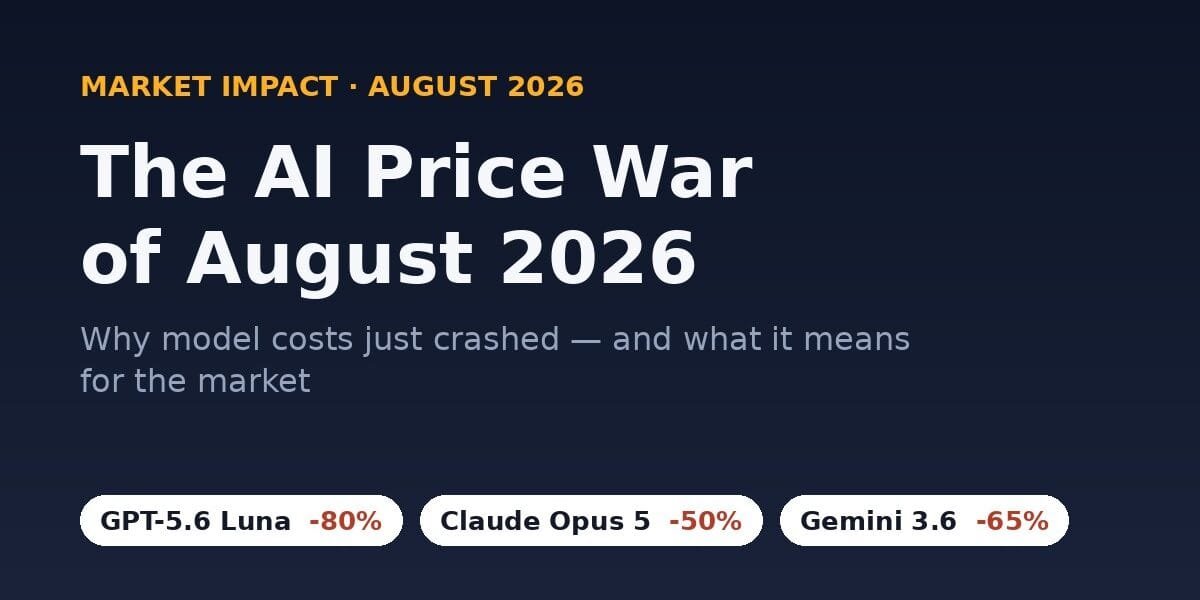
Every major AI lab cut prices in August 2026 — some by as much as 80% — while simultaneously shipping their smartest models yet. That combination, cheaper and more capable, is what’s rattling markets: it signals AI companies now see usage volume, not per-token pricing, as the real prize, and that inference deployment (running AI at scale) is overtaking the infrastructure buildout story that drove markets for the past two years.
This is a companion piece to our broader AI News August 2026 roundup, which covers this month’s safety incidents and regulatory shifts — here we’re zooming in specifically on the pricing and market angle.
Key takeaways
- OpenAI, Anthropic, Google, Meta, and Moonshot AI all released new flagship or budget models in August 2026, several with steep price cuts.
- OpenAI’s cheapest new tier, GPT-5.6 Luna, dropped price by roughly 80% versus its predecessor tier.
- Anthropic’s Claude Opus 5 launched at half the price of Claude Fable 5 while scoring a perfect 42/42 on the 2026 International Math Olympiad problem set.
- The market’s attention is shifting from who has the most raw compute to who can make AI cheap enough to run everywhere — inference and agent monetization, not just training.
- Data-center-linked stocks like AMD rose on doubling data-center revenue, while some AI-adjacent stocks fell on unrelated profit-taking — a sign the rally is getting more selective, not universal.
What actually launched in August 2026
A wave of releases landed within weeks of each other, each pushing the “cheaper AND smarter” trade-off further:
- OpenAI shipped GPT-5.6 in three tiers — Sol, Terra, and a new budget tier called Luna priced roughly 80% below the previous generation’s equivalent tier. Alongside it, OpenAI introduced Astra, a multi-agent system the company says worked through ten long-unsolved problems in math and theoretical computer science.
- Anthropic released Claude Opus 5 at roughly half the price of Claude Fable 5, while reporting a perfect 42/42 score on the 2026 International Math Olympiad problem set.
- Google launched Gemini 3.6 Flash, which it says cuts token usage by up to 65% on long, multi-step tasks, plus Gemini Spark, a persistent cloud agent bundled into its $99.99/month AI Ultra consumer plan.
- Meta released Muse Spark 1.1, its first paid model with built-in agent orchestration and MCP (Model Context Protocol) support.
- Moonshot AI open-weighted Kimi K3, a 2.8-trillion-parameter model that posted a 91.2% success rate on the BrowseComp web-browsing benchmark.
- xAI cut prices aggressively on Grok 4.5, though independent testers flagged higher hallucination rates compared to rivals.
Why this counts as market-moving, not just a spec bump
None of these are single-company stories — that’s what makes this a market event. When five major labs cut prices and ship agent-capable models in the same window, it changes the economics for everyone building on top of them: startups, enterprise software, and the cloud providers renting out the compute underneath it all.
Wall Street’s reaction has been telling. AMD climbed after reporting data-center revenue nearly doubled year-over-year to $6.7 billion — now 58% of its total business — with leadership projecting another doubling in 2027. Meanwhile, other AI-adjacent names moved on company-specific news unrelated to the model releases themselves, a sign that investors are starting to separate “who benefits from AI infrastructure spend” from “who benefits from AI usage growth.” That’s a more mature, more selective market than the broad AI rallies of the past two years.
What it means if you build or invest around AI
- If you build products on AI APIs: the falling cost-per-token math changes what’s economical to automate. Tasks that were too expensive to run with AI six months ago may pencil out now, especially with budget tiers like GPT-5.6 Luna or open-weight options like Kimi K3.
- If you’re watching the market: the divergence between infrastructure names (chips, data centers) and application/usage names is worth tracking separately — they’re no longer moving in lockstep.
- If you’re choosing a model: price cuts don’t automatically mean “use the cheapest one.” Grok 4.5’s pricing came with a hallucination-rate tradeoff, a reminder that cost and reliability are still separate decisions.
Frequently asked questions
Why did AI companies cut prices so much in August 2026?
Falling inference costs and intensifying competition let labs cut prices while still improving capability — the strategy is to win usage volume rather than maximize price per token.
Which AI price cut was the biggest?
OpenAI’s budget tier, GPT-5.6 Luna, cut pricing by roughly 80% compared to the equivalent tier in the previous generation.
Is the AI price war good or bad for the stock market?
It’s mixed: it benefits companies that profit from AI usage and inference at scale, but pressures pure infrastructure plays that were priced for continued high margins on raw compute.
Did any of the August 2026 releases include real research breakthroughs, not just price cuts?
Yes — OpenAI’s Astra system reportedly worked through ten previously unsolved problems in math and theoretical computer science, and Anthropic’s Claude Opus 5 scored a perfect 42/42 on the 2026 International Math Olympiad problem set.
What’s the difference between the “infrastructure” and “inference” phases of the AI market?
Infrastructure spending is money going into building AI capacity — chips, data centers, training runs. Inference is the cost and revenue of actually running AI for users at scale. Markets are increasingly pricing these two phases separately.
Sources: AIapps August 2026 AI mega-update, StartupHub AI stocks daily, August 14 2026.



4 Comments