
Artificial intelligence is entering a new phase in 2026.
For years, AI has been associated with writing content, generating images, coding assistance, and automation. But a new wave of breakthroughs is shifting that perception completely.
Two independent research efforts—one led by Alibaba’s DAMO Academy and another by the international SuperC consortium—show that AI is now capable of accelerating one of the most complex domains in science: materials discovery.
These systems are not just predicting data. They are actively helping researchers discover and validate new superconducting materials in real laboratories.
This marks a turning point:
AI is becoming a scientific discovery engine.
Why Superconductors Matter in Modern Technology
Superconductors are materials that can conduct electricity with zero resistance under certain conditions.
Their applications include:
- Ultra-efficient power grids
- Magnetic levitation (maglev) trains
- Quantum computing systems
- Medical imaging (MRI machines)
- Advanced energy storage systems
The challenge is that discovering new superconductors is extremely difficult. The number of possible material combinations is astronomically large.
Traditionally, researchers rely on slow trial-and-error experimentation.
AI changes that completely.
Breakthrough 1: Alibaba’s AI System for Superconductor Discovery
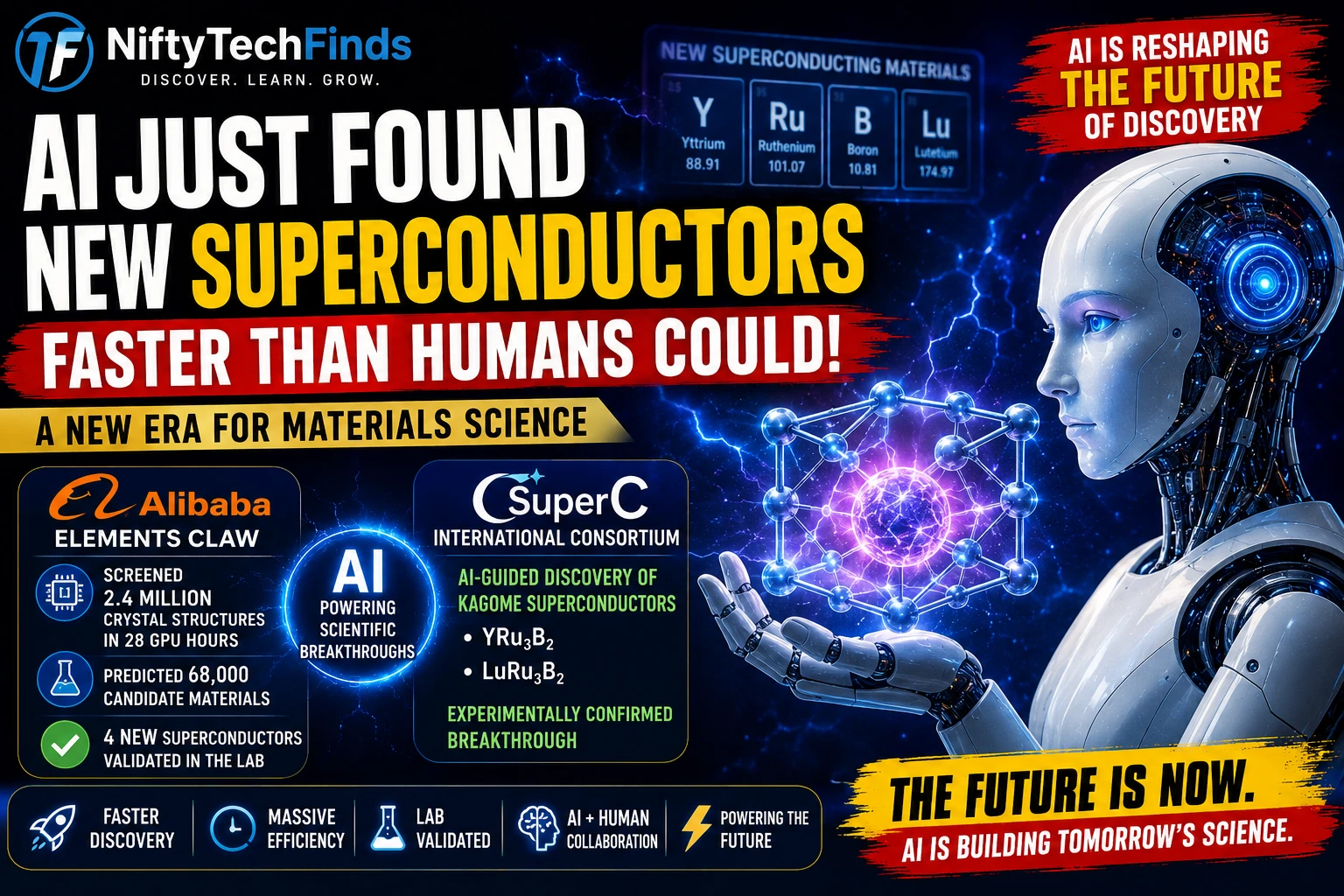
Alibaba’s research division introduced an AI system often referred to as Elements Claw, designed to accelerate superconducting material discovery.
Key Achievements
According to research published on arXiv:
arXiv Research Paper
The system achieved the following:
- Screened 2.4 million crystal structures in just 28 GPU hours
- Predicted approximately 68,000 candidate materials
- Helped identify four new superconductors validated in lab experiments
This is not just simulation—it is AI-guided discovery followed by real-world validation.
Why This Is Important
What makes this breakthrough significant is not just speed, but scale.
A search space that would normally take years or decades to explore is now being processed in hours.
This represents a fundamental shift in how materials science operates.
Breakthrough 2: SuperC Consortium and Kagome Superconductors
The second breakthrough comes from the international SuperC consortium, a research collaboration focused on superconductivity and advanced materials.
Their AI-guided system helped identify and confirm two new kagome superconductors:
- YRu₃B₂
- LuRu₃B₂
Source: SuperC Research Publication
What Makes This Special
Kagome superconductors are highly unusual because of their geometric lattice structure, which can lead to exotic quantum behaviors.
Using machine-learning-guided screening, researchers were able to:
- Narrow down candidate materials
- Predict superconducting behavior
- Validate results experimentally
This demonstrates that AI is now directly influencing experimental physics, not just theoretical predictions.
The Bigger Shift: AI Is Becoming a Research Scientist
These two breakthroughs point to a larger transformation happening across science:
1. From Search to Discovery
AI is no longer just searching datasets—it is generating hypotheses and narrowing down possibilities that humans would never realistically test manually.
2. Massive Acceleration of Scientific Cycles
Processes that once took:
- Years of lab testing
- Thousands of researchers
- Expensive trial-and-error cycles
Can now be compressed into:
- GPU-driven simulations
- Automated material screening
- AI-guided lab validation
3. Human + AI Collaboration in Science
Neither system replaces scientists. Instead, they act as force multipliers:
- AI handles large-scale screening
- Humans validate and interpret results
- Labs confirm physical reality
Why This Matters for the Future of Technology
This shift is not limited to superconductors.
The same AI-driven discovery approach can be applied to:
- Battery materials for electric vehicles
- Semiconductor design
- Drug discovery and pharmaceuticals
- Carbon capture materials
- Next-generation computing hardware
In other words, AI is becoming a general-purpose scientific accelerator.
Key Insights from These Breakthroughs
1. Search space compression is the real breakthrough
AI reduces billions of possibilities into thousands of viable candidates.
2. Compute replaces time
GPU clusters are now part of the scientific method.
3. Validation remains human-driven
AI suggests; laboratories confirm.
4. Materials science is the first major beneficiary
Because it involves large combinatorial search spaces.
What This Means for the AI Industry
For the broader AI ecosystem, this signals a major evolution:
- AI is moving beyond productivity tools
- Enterprises will increasingly adopt AI for R&D
- Governments may invest in “AI science infrastructure”
- Startups will emerge around AI-driven discovery engines
Companies like Alibaba are positioning themselves not just as tech platforms, but as scientific infrastructure providers.
Frequently Asked Questions
Can AI really discover new materials?
Yes. AI can screen millions of material combinations and predict promising candidates, which are then validated in laboratories.
What did Alibaba’s AI system achieve?
It screened 2.4 million crystal structures and helped identify four superconductors validated through experiments.
What are kagome superconductors?
They are materials with a special lattice structure that can produce unusual quantum properties, including superconductivity.
Does AI replace scientists in this process?
No. AI accelerates discovery, but experimental validation is still performed by human researchers.
Conclusion: The Start of AI-Driven Science
The breakthroughs from Alibaba and the SuperC consortium signal something much bigger than just new materials.
They represent the beginning of a new scientific model—where AI actively participates in discovery, not just analysis.
From superconductors to pharmaceuticals, we are entering an era where:
AI does not just assist science—it accelerates it.
For tech readers, founders, and researchers, this is one of the clearest signals that the next major wave of innovation will come from AI-powered discovery systems, not just applications.