
 Madan Chauhan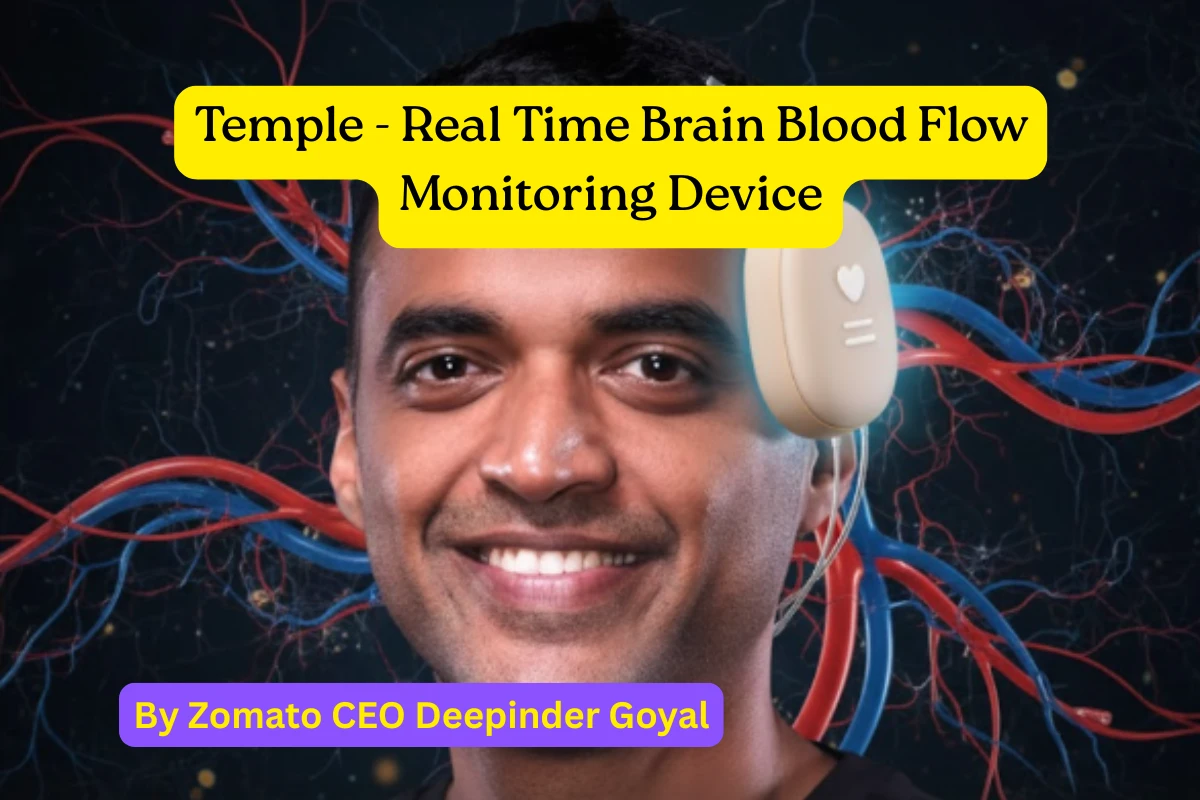
Deepinder Goyal, founder and CEO of Eternal Limited (Zomato’s parent company), officially unveiled Temple—a groundbreaking wearable device designed to monitor cerebral blood flow in real-time. The December 6, 2025 Instagram reveal showed a compact golden sensor with the caption “Getting there,” ending months of speculation after Goyal was photographed wearing the experimental device on his right temple. Temple brain monitoring wearable represents a significant leap into consumer health technology, backed by $50 million in funding from investors including Steadview Capital, Vy Capital, Info Edge, and Peak XV Partners.
Similar to how AI agents are transforming work automation, Temple aims to democratize brain health monitoring previously confined to clinical settings.
What Is Temple and How Does It Work
Revolutionary Brain Flow Monitoring Technology
Temple is a non-invasive brain monitoring device that tracks blood flow to the brain continuously throughout the day. According to Goyal, the device was created as “an experimental device to calculate Brain Flow accurately, real-time, and continuously” under his longevity research initiative Continue Research. The compact sensor sits on the temple area—hence the product name—providing 24/7 cerebral blood flow data.
Goyal revealed he has been testing the device for approximately one year, stating “I have been feeling that this could shape into an important wearable the world needs”. The extended testing period suggests Temple has progressed beyond prototype stage into functional product development.
The Technology Behind Temple
While Goyal hasn’t disclosed the exact technology powering Temple brain monitoring wearable, the device likely uses functional near-infrared spectroscopy (fNIRS)—the same technology employed by advanced brain monitoring systems in medical settings. fNIRS works by using near-infrared light to measure cortical hemodynamic activity and tissue oxygenation, providing real-time data on cerebral blood flow.
Recent innovations in wearable fNIRS technology have made continuous brain monitoring feasible outside clinical environments. Researchers developed wireless, wearable brain sensors using printed circuit boards with skin-facing LEDs and photodetectors coated in biocompatible materials like Parylene-C. A two-layer circuit board design places sensors against skin while keeping electronics on the reverse side, with flexible shrouds enhancing comfort and blocking ambient light.
Similarly, laser-based speckle contrast optical spectroscopy (SCOS) devices developed in 2024 can non-invasively monitor changes in brain blood flow by positioning detectors at least 2.3 centimeters from the laser source. These technological breakthroughs enable Temple’s continuous monitoring capabilities in a compact, wearable form factor.
The Science: Gravity Ageing Hypothesis
Brain Blood Flow and Human Aging
Temple emerged from Goyal’s controversial Gravity Ageing Hypothesis, which suggests that gravity-induced reductions in cerebral blood flow may accelerate aging. The theory proposes that during the approximately 16 hours humans spend upright daily, gravity creates chronic reduction in brain blood flow, particularly to deep brain structures like the hypothalamus and brainstem.
According to Continue Research’s published hypothesis, cerebral blood flow (CBF) declines by 0.3-0.74% each year in healthy aging, resulting in a 20-40% loss between ages 20 and 80. This cumulative reduction affects brain regions that regulate heart rate, breathing, temperature, hormones, inflammation, and immune response. The hypothesis argues that “brain aging becomes body aging” as these control regions degrade and the systems they govern spiral into dysfunction.
Goyal emphasized that his research identified gravity as an overlooked constant factor across all living organisms, potentially explaining why upright-walking humans age differently than quadrupedal mammals. The hypothesis proposes that inversions (positioning the head below the heart) could counter gravity’s effects by temporarily increasing brain blood flow.
Clinical Evidence Supporting Brain Flow Monitoring
While the Gravity Ageing Hypothesis remains experimental, the importance of cerebral blood flow as a biomarker is well-established in neuroscience. Low CBF nearly doubles all-cause mortality risk, independent of heart health. Medical research confirms that non-invasive monitoring of cerebral tissue oxygenation and perfusion has “great potential” for detecting stroke, brain injury, and dementia.
Goyal clarified that “Brain Flow is already well accepted as a biomarker for aging, longevity as well as cognition. So this device is useful and relevant even if the Gravity Aging Hypothesis turns out to be wrong”. This positions Temple as scientifically grounded regardless of whether the gravity hypothesis proves correct.
Temple’s $50 Million Funding Round
Major Venture Capital Backing
Temple is in advanced talks to raise $50 million (approximately ₹450 crore) in seed funding from Steadview Capital, Vy Capital, Info Edge, and Peak XV Partners (formerly Sequoia Capital India). The funding round would value the startup at approximately $125-130 million, making it one of the largest seed rounds by an Indian startup in recent years.
Notably, many of these investors backed Zomato in its early stages, demonstrating continued confidence in Goyal’s entrepreneurial vision. Goyal, along with other Indian founders and Temple employees, will also invest in the seed round.
Goyal previously backed Continue Research with $25 million of his own capital in October 2024, demonstrating significant personal commitment to the longevity research initiative. The additional $50 million institutional funding will accelerate product development, regulatory approvals, and commercial launch preparations.
Strategic Market Positioning
This positions Temple brain monitoring wearable in the rapidly expanding wearable brain devices market, valued at $353.16 million in 2024 and expected to reach $1,370.58 million by 2035, growing at a compound annual growth rate of 13.12%. More aggressive projections estimate the global market reaching $2,465.72 million by 2032 with a 23.18% CAGR.
The market growth is driven by advancements in sensor technologies, increasing prevalence of neurological disorders like Alzheimer’s disease, epilepsy, and Parkinson’s disease, and consumer focus on cognitive well-being. Demand for accessible, non-invasive methods to monitor brain health outside clinical settings creates a substantial opportunity for Temple.
How Temple Compares to Existing Brain Monitoring Technology
Consumer Wearables Gap
Temple enters a market where established wearables like Whoop and Oura Ring focus on heart rate variability, sleep tracking, and body temperature—but none currently offer cerebral blood flow monitoring. This gives Temple a potential first-mover advantage in consumer brain health tracking.
Just as AI video editing tools revolutionized content creation, Temple aims to democratize brain health monitoring. While fitness trackers made heart data accessible to millions, no mainstream wearable currently monitors the brain’s most critical biomarker: blood flow.
Clinical-Grade Alternatives
Existing cerebral monitoring devices are primarily medical-grade instruments used in clinical settings. The CerOx monitor employs UTLight technology using near-infrared light and ultrasound to measure blood flow and regional oxygen saturation in hospital environments. Other systems use laser speckle contrast optical spectroscopy (SCOS) or electromagnetic coupling sensing (ECS) to detect variations in brain conductivity during surgical procedures.
Temple’s innovation lies in making this technology wearable and accessible for continuous monitoring outside hospital environments. The device’s compact form factor and wireless Bluetooth connectivity enable real-time data transmission to smartphones or laptops for analysis.
Wearable fNIRS Technology Advances
Recent breakthroughs in wearable fNIRS sensors demonstrate the technological feasibility of Temple’s approach. Researchers developed systems featuring unrestricted user mobility through Bluetooth connections, enabling long-term patient monitoring. These sensors detect oxy- and deoxy-hemoglobin changes on the forehead region, indicating neuronal activity and providing information for brain activity monitoring studies.
The integration of AI and machine learning with these sensors creates opportunities for personalized brain health insights. Temple could potentially leverage similar AI capabilities for detecting cognitive fatigue, analyzing brain aging patterns, and providing actionable longevity recommendations.
Product Availability and Launch Timeline
Phased Rollout Strategy
According to sources, Temple initially plans to sell the research device to research institutes worldwide before a broader consumer launch. This phased approach allows scientific validation through academic partnerships while building credibility for eventual consumer adoption.
The “Coming Soon” teaser shared on December 6, 2025 suggests a commercial release may happen in early 2025, though no official date has been announced. Goyal’s Instagram post featuring the device with caption “Getting there” indicates development has reached advanced stages.
Temple’s regulatory pathway remains undisclosed, though medical-grade wearables typically require approvals from bodies like the FDA (United States) or CDSCO (India) depending on intended claims and market. The initial focus on research institutes may circumvent some consumer regulatory requirements while gathering clinical evidence.
Continue Research Initiative
Temple operates under Goyal’s broader Continue Research initiative, a biological research venture focused on longevity science. Continue Research unveiled its first hypothesis—Gravity Ageing—in November 2024, positioning Temple as the practical tool to test and validate this theory.
Goyal explained that Continue Research wasn’t created to market devices but emerged from genuine research findings showing inversion tables increased daily average brain flow by 7%, potentially offsetting ten years of age-related decline. Temple’s development followed naturally from the need to accurately measure these effects.
Why Temple Matters for Consumer Health Tech
Filling a Critical Gap
Temple brain monitoring wearable represents an unexpected but strategic diversification for Eternal, which has traditionally focused on food delivery (Zomato), quick-commerce (Blinkit), restaurant supplies (Hyperpure), and events (District). The venture signals growing interest in longevity technology and preventive health monitoring among tech entrepreneurs.
If successful, Temple could democratize brain health monitoring the same way fitness trackers popularized heart rate and sleep data. Users can easily track steps, calories, and sleep patterns with existing wearables, but no mainstream device currently monitors cerebral blood flow—despite its critical importance for cognitive health and longevity.
India’s Longevity Tech Sector
Temple represents India’s growing longevity tech sector, blending consumer wearables with upstream biological science. The venture follows global trends where tech founders increasingly invest in health and longevity startups, recognizing aging as a solvable engineering problem.
Similar to how ByteDance’s Doubao AI demonstrates agentic capabilities, Temple showcases how Indian tech leaders are pushing into deep-tech biological innovation.
Potential Applications Beyond Aging
While developed to test the Gravity Ageing Hypothesis, Temple’s applications extend far beyond longevity research. Continuous cerebral blood flow monitoring could benefit:
- Cognitive performance tracking for professionals and students monitoring mental fatigue
- Neurological disorder management for Alzheimer’s, Parkinson’s, and epilepsy patients
- Stroke risk assessment through early detection of abnormal blood flow patterns
- Sports optimization for athletes tracking brain oxygenation during training
- Mental health monitoring detecting physiological markers of stress and anxiety
Goyal emphasized that brain blood flow is already recognized as a key biomarker for aging, longevity, and cognitive health—making Temple relevant across multiple use cases regardless of the Gravity Ageing Hypothesis’s validity.
Technical Specifications and Features
Expected Device Capabilities
Based on comparable wearable fNIRS systems, Temple likely features:
- Wireless Bluetooth connectivity for seamless smartphone/laptop integration
- Real-time data transmission enabling continuous monitoring without device removal
- Lightweight design approximately the size of a bandage for all-day comfort
- Biocompatible materials such as Parylene-C coating for skin safety during extended wear
- Rechargeable battery supporting multi-day operation between charges
- AI-driven analysis potentially detecting patterns and providing personalized insights
The device’s temple placement optimizes access to the prefrontal cortex (PFC)—a brain region key to decision-making, memory, and higher-order thinking. This positioning balances signal quality with wearability and aesthetic considerations.
Smartphone Integration
Temple will likely include companion software collecting raw data, storing measurements, and generating real-time analyses. Modern wearable fNIRS systems demonstrate that connected devices can display oxy- and deoxy-hemoglobin changes, track trends over time, and alert users to significant variations.
Integration with health platforms like Apple Health or Google Fit could position Temple alongside existing fitness wearables, creating comprehensive personal health dashboards. The combination of cerebral, cardiovascular, and metabolic data would provide unprecedented holistic health insights.
Market Opportunity and Competition
Wearable Brain Devices Market Growth
The wearable brain devices market exhibits rapid growth as healthcare organizations and consumer wellness applications demand more non-invasive neurotechnology solutions. Key growth opportunities include expansion in home-based cognitive therapy and remote neuro-monitoring, integration with AI and machine learning for personalized brain health insights, and untapped potential in emerging markets with rising healthcare awareness.
The U.S. market, valued at approximately $99.6 million in 2024, represents the largest regional market for wearable brain devices. However, Asia-Pacific regions show accelerating adoption driven by aging populations and increasing healthcare investments.
Competitive Landscape
Temple enters a market with limited direct competition in consumer cerebral blood flow monitoring. Existing players focus on:
- EEG-based wearables (Muse, NeuroSky) measuring electrical brain activity rather than blood flow
- Medical-grade monitors (CerOx, SCOS systems) designed for clinical rather than consumer use
- Fitness wearables (Whoop, Oura) tracking peripheral but not cerebral metrics
This competitive gap provides Temple first-mover advantage in a category it essentially creates. Success depends on demonstrating clear value propositions that justify additional wearable adoption beyond existing fitness trackers.
Challenges and Considerations
Regulatory Approval Process
Medical wearables face varying regulatory requirements depending on intended claims. If Temple markets itself as a medical device diagnosing or treating conditions, it requires rigorous FDA (U.S.) or CDSCO (India) approval processes. Positioning as a general wellness device with informational rather than diagnostic claims could expedite market entry.
Temple’s initial focus on research institutes may provide clinical validation data supporting eventual consumer regulatory submissions. Academic partnerships generating peer-reviewed studies would strengthen credibility and regulatory applications.
Consumer Adoption Barriers
Successfully launching Temple requires overcoming several adoption challenges:
- Education gap: Most consumers lack awareness of cerebral blood flow’s importance
- Wearable fatigue: Users already wear smartwatches, fitness bands, and continuous glucose monitors
- Aesthetic concerns: Visible forehead device may face social acceptance challenges
- Pricing uncertainty: Premium pricing could limit market penetration versus accessible pricing building volume
- Data interpretation: Users need clear, actionable insights rather than raw measurements
Temple’s success depends on communicating compelling value propositions and demonstrating tangible health benefits justifying adoption.
Scientific Validation
The Gravity Ageing Hypothesis remains controversial and requires extensive peer review and replication studies. However, Goyal strategically positioned Temple’s value independently of the hypothesis’s validation. Since cerebral blood flow monitoring provides established clinical value regardless of gravity’s role in aging, Temple maintains relevance even if the underlying theory proves incomplete.
Future Implications for Health Technology
Democratizing Brain Health Monitoring
The combination of proven neuroscience backing cerebral blood flow’s importance, emerging wearable fNIRS technology, and Goyal’s track record building billion-dollar companies makes Temple brain monitoring wearable one of the most intriguing health tech launches to watch in 2025. If successful, Temple could create an entirely new category of consumer brain health devices.
Similar to how AI presentation tools transformed workplace productivity, Temple could fundamentally change how individuals understand and optimize cognitive performance. The shift from reactive healthcare (treating problems) to proactive monitoring (preventing decline) represents the broader transformation occurring across consumer health technology.
Integration with Longevity Ecosystem
Temple positions within a growing longevity technology ecosystem including:
- Continuous glucose monitors (CGMs) tracking metabolic health
- Wearable ECG devices (Apple Watch, Kardia) monitoring cardiac function
- Sleep optimization devices (Oura Ring, Eight Sleep) improving recovery
- NAD+ supplements and senolytics targeting cellular aging
- AI health coaches providing personalized recommendations
Temple adds the missing cerebral health dimension, enabling unprecedented comprehensive health monitoring. Integration across these platforms could generate holistic insights about how lifestyle factors affect brain, heart, and metabolic health simultaneously.
Research Applications
Temple’s initial focus on research institutes creates opportunities for groundbreaking neuroscience studies. Continuous, long-term brain blood flow monitoring outside clinical settings enables research previously impossible with existing technology. Potential research applications include:
- Aging studies tracking cerebral decline over years in natural environments
- Cognitive intervention trials measuring brain flow changes from meditation, exercise, or nootropics
- Sleep research understanding cerebral circulation during different sleep stages
- Altitude studies examining brain oxygenation in high-altitude environments
- Pharmaceutical trials assessing cerebrovascular effects of new compounds
Academic partnerships could generate publication pipelines validating Temple’s accuracy against gold-standard clinical measurements.
For readers interested in cutting-edge technology, Temple represents convergence of wearable sensors, AI analysis, and biological research creating entirely new product categories. The device’s development parallels innovations covered extensively on niftytechfinds.com including AI agents automating complex work, ChatGPT Operator enabling autonomous web tasks, and text-to-video AI tools democratizing content creation.
Temple’s $50 million funding round validates that major investors recognize longevity technology’s enormous market potential. As populations age globally and healthcare costs escalate, preventive monitoring devices enabling early intervention could generate substantial healthcare savings while improving quality of life.
Whether the Gravity Ageing Hypothesis proves correct or not, Temple addresses a genuine gap in consumer health technology. The ability to monitor cerebral blood flow—a biomarker linked to cognitive health, longevity, and neurological disease risk—represents meaningful innovation regardless of the underlying theoretical framework.
The device’s anticipated early 2025 launch will reveal whether consumers embrace visible brain wearables and whether Temple’s data provides actionable insights justifying adoption. Success could catalyze an entirely new category of cognitive health wearables, while challenges could offer lessons about bringing cutting-edge neuroscience research into consumer products.
Stay updated on Temple’s launch and other groundbreaking innovations by following niftytechfinds.com for comprehensive coverage of AI tools, health tech, and emerging technologies shaping our future.
