
 Madan Chauhan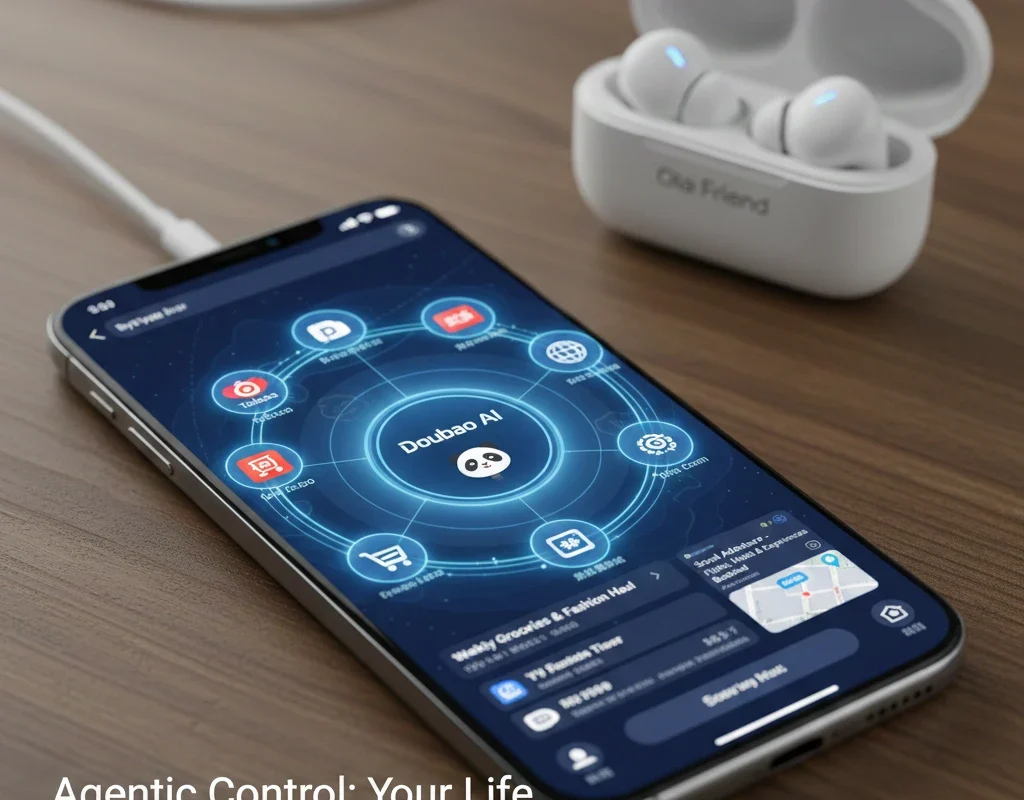
The biggest shift ByteDance is leading in late 2025 is the transition from Generative AI (creating text/images) to Agentic AI (doing tasks). The new Doubao Phone Assistant is not just an app; it is a system-level interface that sits on top of the Android operating system.
Unlike Siri or Google Assistant, which often hand you off to a web search, Doubao has “full permissions” to navigate third-party applications for you. In a live technical preview on the Nubia M153 (a reference device priced at ~3,499 RMB), the assistant demonstrated capabilities that feel like science fiction:
- Cross-App Autonomy: If you ask for the best price on a specific pair of sneakers, Doubao autonomously opens JD.com, Taobao, Pinduoduo, and Douyin Mall. It scans the screens, identifies the products, compares the final prices (including coupons), and presents the cheapest option for a one-click purchase. Crucially, despite being owned by ByteDance, it does not artificially favor its own Douyin Mall, prioritizing user trust over platform bias.
- Complex Workflows: Beyond shopping, it can “book a cinema ticket for a Marvel movie on Friday night” by finding showtimes, selecting seats based on your preferences (e.g., “middle row”), and navigating the payment screen.
- Context Awareness: The assistant can “see” your screen. If you are looking at a photo of a landmark, you can simply ask, “How do I get there?” and it will open a ride-hailing app with the destination pre-filled.
This “OS-level collaboration” solves ByteDance’s long-standing “entry anxiety”—the fear of being just another app at the mercy of Apple or Google. By becoming the interface itself, they control the user journey.
The Hardware Tether: Ola Friend Earbuds
ByteDance understands that an AI assistant is useless if it stays in your pocket. To ensure “always-on” access, they launched the Ola Friend smart earbuds.
- The “Her” Experience: Reviews compare the interaction to the movie Her. The voice assistant uses a “speech-to-speech” model that allows for real-time interruptions and emotional nuance. It can laugh, express surprise, or sound empathetic, removing the robotic lag typical of older assistants.
- Physical Design: These are open-ear wearables weighing just 6.6 grams, designed to be worn all day without blocking ambient sound. They serve as a dedicated hardware button for the Doubao ecosystem—users can wake the assistant with a phrase or a touch, bypassing the phone entirely.
- Strategic Value: For ByteDance, these $170 earbuds are a data pipeline. They capture voice queries and intent throughout the day, feeding the Doubao LLM with real-world context that a text-based chatbot never sees.
By The Numbers: The Scale of Doubao
To understand why this matters, we must look at the sheer scale of adoption. While Western media focuses on OpenAI, Doubao has become the de-facto AI utility for China’s massive internet population.
Key Metrics (Late 2025):
Note: The wide range in DeepSeek’s MAU estimates reflects different tracking methodologies across platforms like QuestMobile and Aicpb.com.
This dominance is fueled by Volcengine, ByteDance’s cloud division. By pricing their tokens aggressively low (often 99% cheaper than GPT-4 at launch), they forced a “price war” that decimated smaller competitors and made Doubao the standard infrastructure for enterprise AI in China.
The “Parallel Universe” of AI
For tech enthusiasts and investors, the rise of Doubao signals a bifurcation in the global AI landscape. We are now seeing two distinct “AI Universes”:
- The Western Stack: Centered on Reasoning (OpenAI o1/GPT-5), productivity, and SaaS integration (Microsoft/Google). The focus is on “smarter” models that can code and solve math problems.
- The Chinese Stack: Centered on Application (Doubao), mobile integration, and O2O (Online-to-Offline) commerce. The focus is on “useful” agents that interact with the physical world and messy app ecosystems.
ByteDance’s strategy is clear: they don’t need the smartest model that can pass the Bar Exam; they want the most helpful model that can order your dinner. By integrating Doubao into the OS layer, they are betting that convenience wins over raw IQ.
Conclusion: The Death of the App Store?
The Doubao Phone Assistant offers a glimpse into a future where the “App Store” model becomes obsolete. If an AI agent can navigate apps for you, you no longer need to learn distinct interfaces for booking flights, buying clothes, or ordering taxis. You just speak.
For niche bloggers and developers, this is a wake-up call. SEO in 2026 won’t just be about ranking on Google; it will be about being “readable” by AI agents like Doubao. If your site structure confuses the agent, you simply won’t exist in the results it presents to the user.
ByteDance has proved that the technology works. The question now is not if this will happen in the West, but when Apple or Google will be brave enough to disrupt their own app store monopolies to offer the same capability. Until then, the most advanced consumer AI experience might just be on a $495 phone from ZTE

3 Comments