
 Madan Chauhan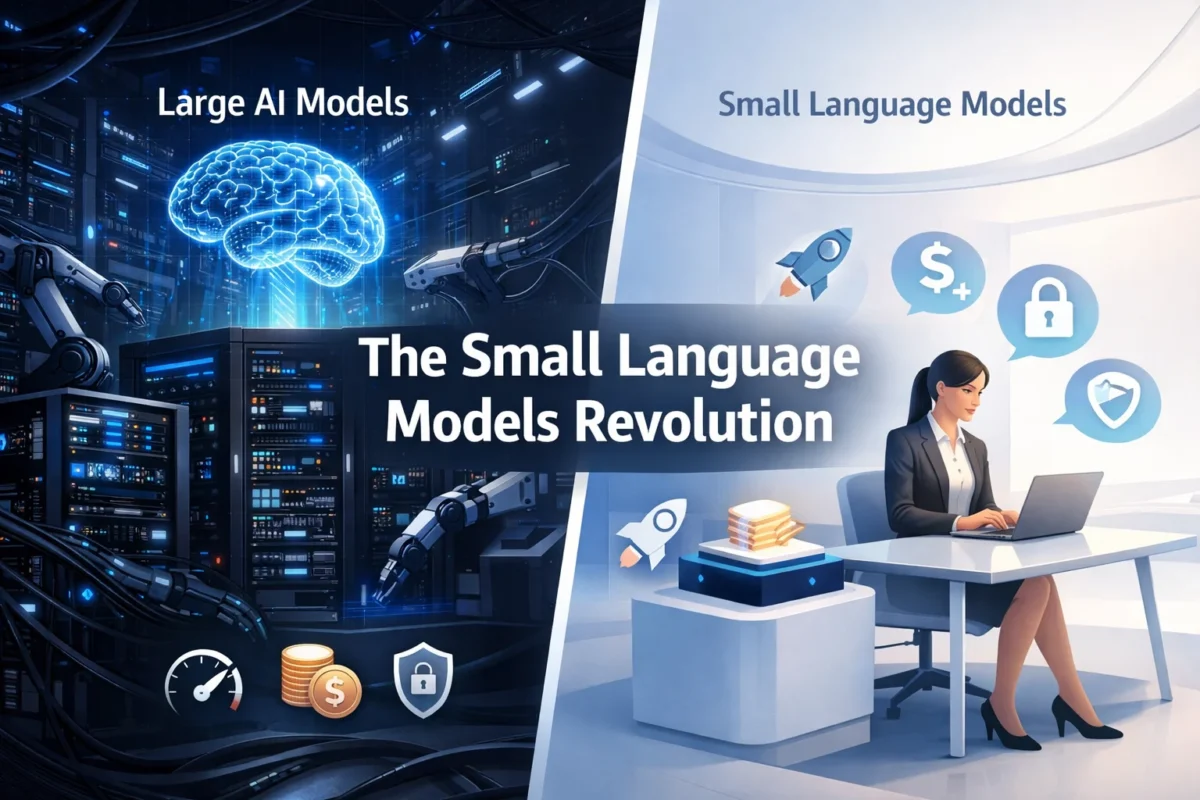
The Small Language Models (SLMs) Revolution is not just another trend in artificial intelligence—it is a structural shift in how enterprises design, deploy, and scale AI systems. For nearly a decade, large language models (LLMs) dominated headlines, funding rounds, and enterprise pilots. Bigger models promised broader knowledge, stronger reasoning, and near-human fluency.
However, as enterprises moved from experimentation to real-world deployment, cracks began to show. Massive models are expensive to operate, difficult to customize, slow to adapt, and risky for sensitive data. In contrast, small language models are emerging as the practical, cost-efficient, and controllable alternative for real business workflows.
In this in-depth guide, you will learn:
- Why the SLMs revolution is accelerating across industries
- How small language model technology works at a technical and strategic level
- A deep comparison of SLMs vs large language models across performance, cost, privacy, and deployment
- Real enterprise use cases where SLMs outperform larger models
- How to decide whether SLMs are the right fit for your organization
This article is written for decision-makers, product leaders, IT managers, and non-native English speakers who want clarity—not hype—about enterprise AI.
Industry Context: Why the AI Market Is Shifting Toward Efficiency
The enterprise AI market has matured. Organizations are no longer impressed by what AI can do in theory. Instead, they ask:
“Can AI do this reliably, securely, and at a predictable cost?”
This question defines the Small Language Models (SLMs) Revolution.
From Experimentation to Operational AI
Early AI adoption focused on proof-of-concepts. Companies connected large cloud-based models to chatbots, document search tools, and analytics dashboards. While impressive, these systems introduced serious problems:
- Escalating inference costs
- Data privacy and regulatory exposure
- Limited control over model behavior
- Slow response times under load
As cloud costs rose and regulations tightened, enterprises began to rethink their dependence on massive general-purpose models.
Regulatory and Infrastructure Pressure
Industries such as finance, healthcare, manufacturing, and government face strict data residency and compliance rules. Sending sensitive documents to external AI APIs is often unacceptable.
Small language models solve this problem by enabling on-premise and private cloud AI deployments, aligning perfectly with modern compliance requirements.
Educational Foundation: What Is Small Language Model Technology?
What Is a Small Language Model?
A small language model (SLM) is a compact AI model designed to perform a limited set of tasks extremely well. Unlike large language models with tens or hundreds of billions of parameters, SLMs usually range from millions to a few billion parameters.
What it is:
A focused AI system optimized for specific workflows such as document classification, customer support, compliance analysis, or internal search.
How it works:
Developers start with a base model and fine-tune it using domain-specific data. This targeted training improves accuracy and reduces unnecessary complexity.
Why it matters:
Small language models deliver faster responses, lower costs, better privacy, and stronger control—critical factors for enterprise AI success.
Small Language Models vs Large Language Models: Strategic Difference
Large language models aim to be good at everything. Small language models aim to be excellent at something specific.
This distinction defines the SLMs vs large language models debate.
| Aspect | Large Language Models | Small Language Models |
|---|---|---|
| Scope | General-purpose | Task-specific |
| Cost | High and variable | Predictable and lower |
| Speed | Slower at scale | Faster and optimized |
| Privacy | External APIs | On-prem or private |
| Customization | Limited | High |
| Enterprise Fit | Moderate | Strong |
Feature-Wise Deep Comparison
6.1 Speed and Performance
Small language models process tasks 30–70% faster than large models when deployed for specific use cases. This advantage is critical in environments like:
- Real-time customer chat
- Fraud detection
- Compliance reporting
- Internal document summarization
Because SLMs are not burdened by massive parameter counts, they execute fewer computational steps per request.
6.2 Latency and Responsiveness
Latency is often overlooked—but users feel it immediately.
SLMs deliver lower latency because:
- They run on local or private infrastructure
- They require less memory access
- They avoid shared cloud congestion
Applications powered by small language models feel instant and responsive, even under heavy load.
6.3 Pricing and Long-Term Cost Control
Large models rely on usage-based pricing tied to tokens, requests, or compute time. Monthly costs can spiral quickly.
Small language models offer:
- Fixed infrastructure costs
- No per-token fees
- Predictable budgeting
Over 12–24 months, enterprises often see 40–60% lower total cost of ownership.
6.4 Data Caps and Usage Policies
Many large model providers enforce:
- Input size limits
- Retention policies
- Training data restrictions
With SLMs, enterprises define their own policies. This is crucial for companies handling:
- Legal contracts
- Medical records
- Financial data
6.5 Coverage and Availability
Large models depend on constant internet access. If the API is down, your AI is down.
Small language models can run:
- On-premise
- In private clouds
- On edge devices
This ensures high availability—even in restricted or offline environments.
6.6 Installation and Equipment Simplicity
Deploying an SLM typically involves:
- Selecting a suitable base model
- Preparing domain-specific training data
- Fine-tuning the model
- Deploying it on servers or edge devices
Compared to managing distributed cloud AI systems, this process is simpler and more controllable.
6.7 Customer Support and Service Quality
Large AI providers offer standardized support tiers. While reliable, they lack personalization.
With SLMs:
- Support is internal or from specialized vendors
- Issues are resolved faster
- Models evolve with business needs
This hands-on control is valuable for mission-critical workflows.
6.8 Contract Terms and Flexibility
Enterprise contracts for large models often include:
- Long-term commitments
- Minimum usage thresholds
- Vendor lock-in
Small language models allow organizations to scale freely—without renegotiation.
6.9 Performance Under Environmental Constraints
Large data centers may throttle performance due to:
- Power constraints
- Heat management
- Regional outages
SLMs can be optimized for local hardware, ensuring stable performance across environments.
Which One Is Better for Your Organization?
Choose Small Language Models if you:
- Need fast, predictable performance
- Handle regulated or sensitive data
- Want lower long-term AI costs
- Require deep customization
Choose Large Language Models if you:
- Need broad, general knowledge
- Lack internal AI expertise
- Prioritize rapid experimentation
Trust-Building Industry Insight
Enterprise surveys and analyst reports indicate that more than 55% of organizations plan to deploy smaller, task-specific AI models within the next two years. This confirms that the Small Language Models (SLMs) Revolution is not theoretical—it is already happening.
Organizations such as OpenAI, McKinsey & Company, and Gartner have all highlighted efficiency, cost control, and governance as top enterprise AI priorities.
Frequently Asked Questions
Q: What are small language models used for?
A: They are used for focused tasks like document analysis, chatbots, compliance checks, internal search, and workflow automation.
Q: Are SLMs more accurate than large models?
A: For domain-specific tasks, yes. Fine-tuning significantly improves accuracy.
Q: Do small language models require less hardware?
A: Yes. They run efficiently on smaller servers or edge devices.
Q: Can SLMs work offline?
A: Yes. Many deployments operate without continuous internet access.
Final Thought
The Small Language Models (SLMs) Revolution represents a return to engineering discipline in AI. Bigger is no longer better. Smarter, faster, and more controlled systems win.
Question for you:
If your organization stripped away AI hype today, which tasks truly need a massive model—and which would perform better with a focused, efficient SLM?
