Discover Your Potential
Enter your name and select a model to reveal your hidden strengths.
MBTI Indicator
Reveals how you perceive the world and make decisions.
DiSC Profile
Analyzes Dominance and Influence in the workplace.
CliftonStrengths
Uncover your top functional talents and leadership domains.
Building a Complete Self-Map
Understanding yourself is the foundation of personal growth and professional success. While one personality assessment can give you useful insights, combining three powerful frameworks creates a much clearer picture of who you are and how you can thrive. MBTI, DISC, and CliftonStrengths each shine a light on different parts of your personality, and together, they create a complete self-map that helps you make better decisions about your career, relationships, and leadership style.
What Each Assessment Measures
MBTI: Your Personality Preferences
The Myers-Briggs Type Indicator (MBTI) explores how you naturally think and make decisions. It measures your preferences across four areas:
Energy Direction: Introversion (I) versus Extraversion (E) — where you get your energy from
Information Processing: Sensing (S) versus Intuition (N) — how you take in information
Decision Making: Thinking (T) versus Feeling (F) — how you make choices
Lifestyle Approach: Judging (J) versus Perceiving (P) — how you organize your life
These preferences combine to create one of 16 personality types (like ENFP or ISTJ). MBTI helps you understand your inner world — why you prefer certain environments, how you process ideas, and what drives your choices. It answers the question: “Who am I at my core?”
DISC: Your Behavioral Style
While MBTI looks inward, DISC looks outward at how you behave, especially in work situations. It measures four behavioral styles:
Dominance (D): Direct, results-focused, decisive behavior.
Influence (I): Outgoing, enthusiastic, people-oriented behavior.
Steadiness (S): Patient, calm, dependable behavior.
Conscientiousness (C): Analytical, detail-oriented, precise behavior.
DISC shows how you naturally act under pressure, how you communicate, and how you approach teamwork. Unlike MBTI, which explores your internal preferences, DISC focuses on your observable actions. It answers the question: “How do I show up in the world?”
CliftonStrengths: Your Natural Talents
CliftonStrengths takes a completely different approach by identifying what you’re naturally good at. Instead of categorizing you into types, it ranks 34 unique talent themes and highlights your top five strengths.
These 34 themes fall into four domains:
Executing: Turning ideas into action (like Achiever, Responsibility, Discipline)
Influencing: Inspiring and persuading others (like Communication, Competition, Self-Assurance)wikipedia+1
Relationship Building: Creating connections (like Empathy, Harmony, Relator)
Strategic Thinking: Analyzing and planning (like Analytical, Futuristic, Learner)
The chances of someone having the same top five strengths as you are one in 33 million. CliftonStrengths helps you understand your unique talents and how to develop them into powerful strengths. It answers the question: “What am I naturally excellent at?”
How Their Perspectives Differ
The key to understanding why these three assessments work so well together is recognizing what makes them different.
MBTI focuses on personality preferences — the internal mental processes that shape how you perceive the world and make decisions. These preferences are fairly stable throughout your life. Think of MBTI as your psychological operating system.
DISC focuses on behavior — the external actions and communication styles you display in different situations. Your DISC profile can shift slightly depending on context and stress levels. Think of DISC as how others experience you.
CliftonStrengths focuses on natural talents — the specific abilities and patterns of thinking that come most naturally to you and energize you. While personality describes how you think, strengths describe what you excel at doing. Think of CliftonStrengths as your unique toolkit.
Research has found significant correlations between these assessments, showing they complement rather than contradict each other. For example, a study found that MBTI’s Introversion (I) strongly correlates with DISC’s Steadiness (S), while MBTI’s Thinking (T) negatively correlates with DISC’s Dominance (D). This means the frameworks are measuring related but distinct aspects of who you are.
Why Combining All Three Gives a More Accurate Picture
Using just one assessment is like looking at yourself through a single lens. Adding two more creates depth and clarity that one alone cannot provide.
Complete Self-Understanding
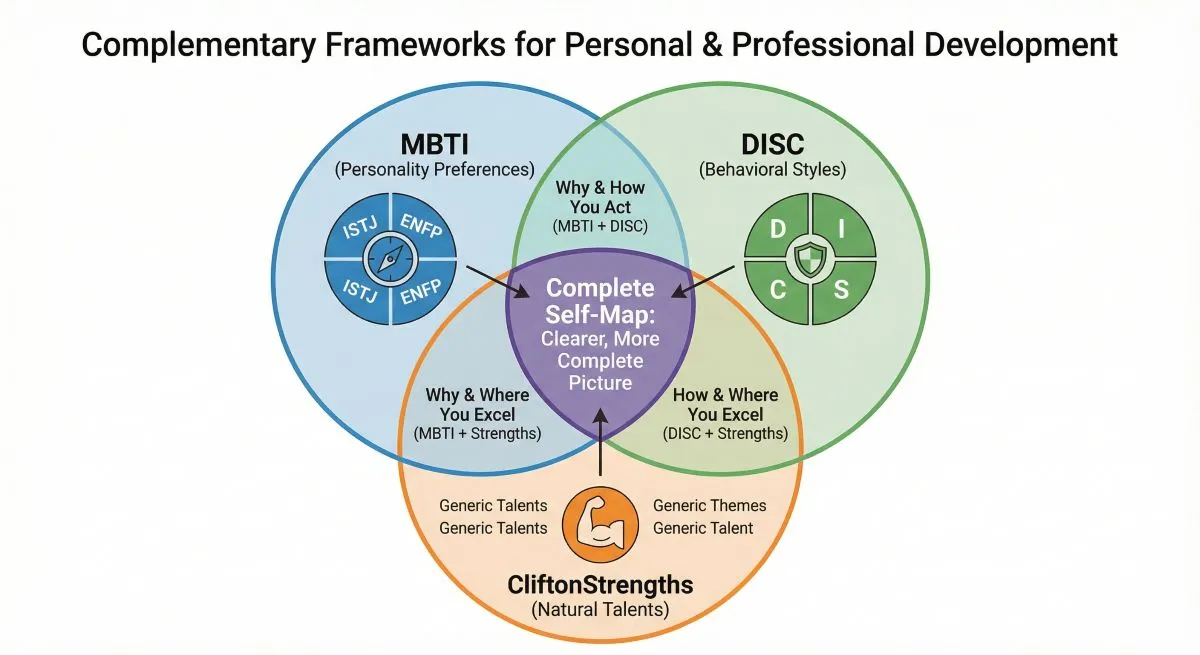
Each assessment fills in gaps the others leave. MBTI tells you why you prefer certain ways of thinking, DISC shows how those preferences translate into behavior, and CliftonStrengths reveals what you can do exceptionally well when you lean into your natural talents. Together, they create a 360-degree view of your personality, behavior, and abilities.
For example, you might be an INTJ (introvert who values logic and planning), have high Conscientiousness in DISC (analytical and detail-focused), and have Strategic and Analytical as top strengths. This combination tells you that you’re not just someone who prefers thinking deeply — you’re someone who excels at careful analysis and long-term planning, and you communicate in precise, thoughtful ways.
Better Career Decisions
When selecting a career, knowing all three dimensions helps you find roles that fit your personality, suit your behavioral style, and use your natural talents.
Research shows that 70% of job satisfaction comes from the fit between your personality and work environment. MBTI helps you identify work environments where you’ll thrive (collaborative versus independent, structured versus flexible). DISC helps you understand which communication styles and team dynamics you’ll handle best. CliftonStrengths points you toward roles where you can use your natural abilities daily.
Someone with ENFP personality (energetic, creative, people-focused), high Influence in DISC (outgoing and persuasive), and strengths like Communication and Woo (winning others over) would thrive in roles like marketing, public relations, or sales where they interact with people, use creativity, and inspire others.
Improved Self-Awareness and Personal Growth
Combining assessments builds deeper self-awareness. You learn not just what you prefer (MBTI), but how those preferences show up in your actions (DISC) and which specific talents you should develop (CliftonStrengths).
This layered understanding helps you make better choices about everything from which projects to pursue to how you manage stress. You can identify patterns like “I prefer working alone (MBTI), I’m careful and methodical in my approach (DISC), and my Deliberative strength means I excel at risk assessment” — giving you clear direction for both personal and professional development.
Real-Life Examples: How Combined Insights Help
Teamwork and Collaboration
Understanding your team’s MBTI types, DISC styles, and CliftonStrengths creates powerful collaboration.
Imagine a project team where one member is an ISTJ with high Conscientiousness and Discipline strength, while another is an ENFP with high Influence and Ideation strength. Without this knowledge, they might clash — one wanting detailed plans and structure while the other brainstorms creative possibilities. With this understanding, the team recognizes that the ISTJ brings careful execution while the ENFP brings innovative thinking. They can divide tasks accordingly and appreciate each other’s contributions.
Teams that use personality assessments report 47% increases in collaboration and communication. They learn to adapt their communication styles, reduce misunderstandings, and leverage diverse strengths.
Leadership Development
Leaders who understand all three frameworks can adapt their leadership style to different team members.
A leader who is an ENTJ (decisive, strategic) with Dominance in DISC and Command strength might naturally give direct instructions and expect fast results. However, if leading a team member who is an ISFJ with Steadiness in DISC and Empathy strength, that direct approach could feel harsh. Understanding these differences, the leader can adjust — providing clear expectations while also building trust and showing appreciation, which the ISFJ needs to perform best.
Studies show that managers who use DISC are 21% more likely to be rated as effective by their teams. When combined with MBTI and CliftonStrengths insights, leaders gain even more tools to motivate, communicate with, and develop their people.
Communication Improvement
The three assessments together dramatically improve how you communicate with others.
MBTI helps you understand whether someone prefers big-picture concepts (Intuition) or specific details (Sensing), and whether they make decisions based on logic (Thinking) or values (Feeling). DISC tells you whether to communicate directly and quickly (Dominance), enthusiastically and socially (Influence), patiently and supportively (Steadiness), or precisely and formally (Conscientiousness). CliftonStrengths reveals what topics energize someone — a person with the Learner strength loves discussing new information, while someone with the Achiever strength wants to focus on results and progress.
By tailoring your communication to all three dimensions, you reduce conflicts and misunderstandings while building stronger relationships.
Career Path Selection
When facing career decisions, combining insights from all three assessments leads to better choices.
Consider someone exploring whether to move into management. Their MBTI type (INFP — values-driven, prefers meaningful work) suggests they’d want to lead in ways that develop people. Their DISC profile (high Steadiness and Influence) shows they naturally build relationships and create harmony. Their CliftonStrengths (Developer, Empathy, Individualization) confirm they have exceptional talents for recognizing and developing others’ potential. All three assessments point toward a people-focused leadership path rather than technical management.
Studies show that people who use personality assessments are 58% more likely to find satisfying career matches and experience 35% higher job satisfaction. Organizations using CliftonStrengths see people become six times more engaged in their jobs and three times more likely to report excellent quality of life.
Bringing It All Together
Think of MBTI, DISC, and CliftonStrengths as three different maps of the same territory — you.
MBTI is your psychological map, showing your natural preferences and how you process the world internally. It reveals why you make the choices you do and what environments feel most natural to you.
DISC is your behavioral map, showing how you act and communicate externally, especially in work situations. It reveals how others experience you and how you can adapt to work better with different personality styles.
CliftonStrengths is your talent map, showing your unique abilities and what you do exceptionally well when operating from your strengths. It reveals where to invest your energy for maximum impact and fulfillment.
Alone, each framework offers valuable insights. Together, they create a complete picture that helps you understand not just who you are, but how to leverage that understanding for success and satisfaction in every area of life.
The goal isn’t to put yourself in a box, but to gain self-awareness that empowers better decisions. When you know your personality preferences, behavioral tendencies, and natural talents, you can choose careers that energize you, build teams that complement each other, communicate in ways that connect with others, and develop your unique strengths into true excellence.
By investing time in understanding all three frameworks, you’re building a foundation for lifelong growth, better relationships, and more meaningful success. That’s the power of a complete self-map.
Discover more insights on personal development, assessments, and professional growth at niftytechfinds.com